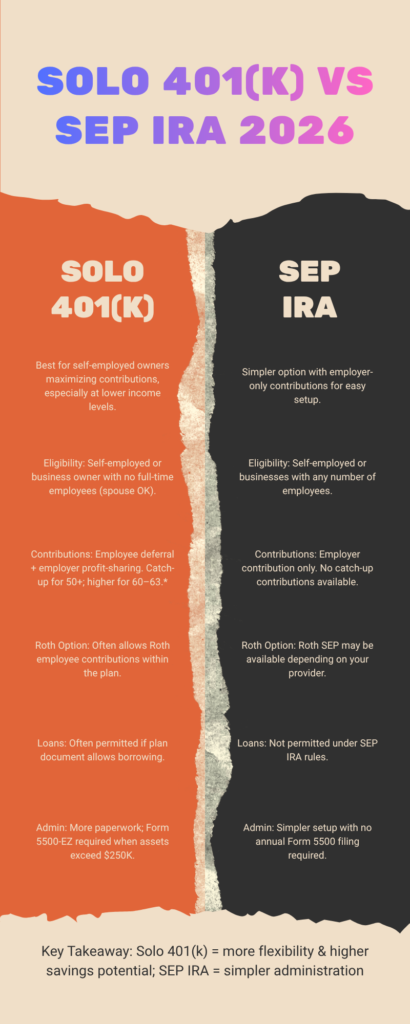
Solo 401(k) vs SEP IRA in 2026 is not just a retirement-plan comparison; it is a real money decision for freelancers, consultants, online business owners, real estate professionals, creators, doctors, designers, and anyone earning income outside a traditional job. When you are self-employed, nobody from HR is walking over with a neat benefits packet and saying, “Here is your retirement plan.” You are the HR department, the payroll team, the investor, and sometimes the person making coffee at midnight. That freedom is exciting, but it also means you must choose the right tax-advantaged retirement vehicle before your best earning years quietly pass by. In 2026, the IRS lists the 401(k) elective deferral limit at $24,500, the standard catch-up amount at $8,000, the higher catch-up amount for ages 60 to 63 at $11,250, and the defined-contribution overall limit at $72,000. The SEP table also shows a $72,000 maximum contribution and a $360,000 compensation cap for 2026.
The real question behind this comparison is simple: do you want maximum control, maximum simplicity, or the best mix of both? A Solo 401(k) can be powerful because the business owner can contribute as both employee and employer. A SEP IRA is popular because it is usually easier to open and maintain. But easier does not always mean better, especially for younger self-employed people or lower-to-mid-income side hustlers who want to save aggressively. Think of the Solo 401(k) like a Swiss Army knife with more tools, while the SEP IRA is like a sharp, simple pocketknife. Both can work beautifully, but they serve different personalities, income patterns, and business plans.
What Is a Solo 401(k)?
A Solo 401(k), also called a one-participant 401(k), is designed for a business owner with no common-law employees other than a spouse.A Solo 401(k), also called a one-participant 401(k), is designed for business owners with no common-law employees. “You can read the official IRS Solo 401(k) rules for more details”.The IRS says this plan is “sometimes called a Solo 401(k), Solo-k, Uni-k, or One-participant k,” and it covers a business owner with no employees, or that owner and their spouse. That is why this choice matters so much for people who are truly solo right now. If you are a freelance writer, independent consultant, e-commerce seller, contractor, YouTuber, or single-owner LLC with no eligible employees, a Solo 401(k) can give you a lot of room to save and plan.
The magic of a Solo 401(k) is that the owner wears two hats. The IRS uses that exact idea, saying the “business owner wears two hats” in the plan: employee and employer. As the employee, you may make elective deferrals up to the annual 401(k) limit. As the employer, your business may also make profit-sharing or nonelective contributions, subject to IRS limits. This dual-role structure is the biggest reason many tax planners love the Solo 401(k). In plain English, it can let a self-employed person contribute meaningfully even when income is not extremely high.
Who Can Open a Solo 401(k)?
You generally need self-employment income and no eligible common-law employees to use a Solo 401(k). A spouse who works in the business may be included, which can make the plan even more useful for couples running a small family business. But if you hire employees who meet plan eligibility requirements, the simple one-person advantage can disappear. The IRS explains that a business owner with no common-law employees does not need nondiscrimination testing because there are no employees who could receive different benefits, but that advantage can vanish when eligible employees are hired. This is one of the most important practical points in this choice.
For example, imagine you are a freelance software developer earning $120,000 in net self-employment income. You have no employees and want to reduce taxable income while investing for retirement. A Solo 401(k) may allow a strong employee deferral plus an employer contribution. Now imagine your business grows and you hire two full-time employees. Suddenly, the plan can become more complicated because retirement benefits may need to be offered fairly. This is not a reason to avoid growth; growth is good. It simply means your retirement plan should match your business stage.
What Is a SEP IRA?
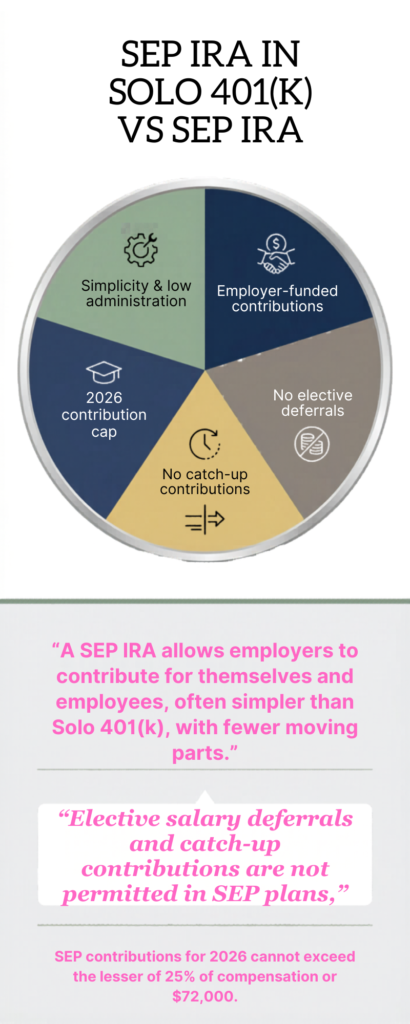
A SEP IRA is a retirement plan that allows employers to contribute to retirement accounts for themselves and eligible employees. The official IRS SEP IRA rules explain how this plan works.
A SEP IRA, or Simplified Employee Pension Individual Retirement Arrangement, is a retirement plan funded by employer contributions. For a self-employed person, that means your business contributes for you. It is often easier to set up than a Solo 401(k), and it has fewer moving parts. In the Solo 401(k) and SEP IRA comparison, the SEP IRA usually wins on simplicity. Many brokers let business owners open a SEP IRA quickly, and ongoing administration is generally lighter than a 401(k)-style plan.
The trade-off is that a SEP IRA does not allow employee elective deferrals or catch-up contributions. The IRS states that SEP contributions cannot exceed the lesser of 25% of compensation or $72,000 for 2026, and it also says, “Elective salary deferrals and catch-up contributions are not permitted in SEP plans.” That one sentence is huge. If you are 52 and trying to turbocharge retirement savings, the lack of catch-up contributions can make a SEP IRA less attractive. If you are earning very high income and want a simple deductible contribution, the SEP IRA can still be excellent.
Who Can Open a SEP IRA?
A SEP IRA can work for sole proprietors, partnerships, corporations, and small businesses with employees. That makes it broader than a Solo 401(k). But there is an important catch: if you have eligible employees, contributions must generally be made using the same percentage of compensation for each eligible employee. In normal human language, you cannot usually give yourself a generous SEP contribution and ignore the team that helped produce the income. This can become expensive if your business has staff.
This is where this comparison becomes less about tax theory and more about real-life cash flow. A SEP IRA looks wonderfully simple when you are alone. But if you have employees, a 10%, 15%, or 25% contribution for yourself may require similar percentage contributions for eligible employees. That is fair, but it can be costly. A business owner who plans to stay solo may see SEP as a clean and easy plan. A business owner who plans to hire aggressively should slow down and compare options carefully with a CPA or retirement-plan specialist.
Quick Comparison Table
Here is a clean side-by-side view of the two plans before we go deeper into the seven key differences.
| Feature | Solo 401(k) | SEP IRA |
|---|---|---|
| Best for | Self-employed owner with no employees except spouse | Self-employed person or small business wanting simplicity |
| 2026 employee deferral | Up to $24,500, if eligible | Not allowed |
| 2026 overall cap | $72,000, excluding catch-up | $72,000 |
| Catch-up contributions | Yes, if plan allows | No |
| Ages 60–63 catch-up | $11,250, if plan allows | No |
| Roth option | Often available if plan document allows | Not a standard SEP IRA feature |
| Employees | Can become complex if eligible employees are hired | Contributions generally must be equal percentage for eligible employees |
| Paperwork | More administration; Form 5500-EZ may apply after $250,000 assets | Generally no Form 5500 filing requirement |
| Simplicity | Moderate | High |
| Savings flexibility | Very high | Moderate |
This comparison has no one-size-fits-all answer. If your income is high and you hate paperwork, the SEP IRA may feel smooth. If your income is moderate and you want to contribute more than a SEP formula would allow, the Solo 401(k) can be stronger. If you want Roth savings, loans, and employee deferrals, the Solo 401(k) may offer more planning room. If you want to open something quickly before a tax deadline and keep administration light, the SEP IRA may feel like a breath of fresh air.
Difference 1 — Contribution Structure
The first major difference in Solo 401(k) vs SEP IRA in 2026 is how contributions are built. A Solo 401(k) has two layers: employee deferral and employer contribution. That means the business owner may contribute as the worker and then again as the business. This is powerful because the employee deferral does not depend on a percentage formula in the same way the employer contribution does. A self-employed person with modest income may still be able to put away a meaningful amount through the employee side of the plan.
A SEP IRA works differently because it is funded only by employer contributions. There is no employee salary deferral, and there is no SEP catch-up contribution for age 50 or older. This matters because the SEP formula can limit how much lower-income or mid-income self-employed people can save. Suppose two people each earn $80,000 from self-employment. The Solo 401(k) user may be able to use the employee deferral first and then add an employer contribution. The SEP IRA user is mainly working with the employer percentage.
Difference 2 — 2026 Contribution Limits
The second big difference is the way the 2026 contribution limits actually feel in practice. On paper, both plans can reach a $72,000 limit for 2026. But paper limits can be misleading because the route to that number is different. The IRS shows $24,500 as the 2026 elective deferral limit for 401(k)-type plans and $72,000 as the defined-contribution limit. It also shows the SEP maximum contribution at $72,000 and maximum compensation at $360,000 for 2026. So yes, the top-line cap may look similar, but the path is not the same.
In this situation, the Solo 401(k) can be more efficient at lower income levels because of that employee deferral layer. A SEP IRA can be excellent for someone with enough compensation to support a large employer contribution, but it may not maximize contributions as easily for someone earning less. This difference is like two roads leading to the same mountain peak. The SEP road may be smooth but long, requiring more income to climb higher. The Solo 401(k) road can be steeper and faster because you start with a strong employee deferral.
Difference 3 — Catch-Up Contributions
If you are age 50 or older, always review the official catch-up contribution rules before deciding which retirement plan is better for you.
Catch-up contributions are where Solo 401(k) vs SEP IRA in 2026 becomes very important for people age 50 and older. A Solo 401(k) may allow catch-up contributions if the plan permits them. For 2026, the IRS lists the standard catch-up amount for 401(k)-type plans as $8,000, and a higher $11,250 catch-up limit applies for people who turn ages 60, 61, 62, or 63 during the calendar year, if the plan allows it. For someone who started retirement saving late, this is not a small detail. It can be the difference between feeling behind forever and finally getting some momentum.
A SEP IRA does not allow catch-up contributions. That means a 55-year-old using a SEP IRA does not get an extra SEP-specific catch-up amount just because they are older. If you are already on track, that may not bother you. But if you are self-employed, age 50-plus, and trying to compress 20 years of saving into 10 or 15 years, a Solo 401(k) may be a better tool. In this plan comparison, catch-up flexibility is one of the Solo 401(k)’s strongest advantages.
Difference 4 — Roth Contribution Options
Roth planning is another major point in Solo 401(k) vs SEP IRA in 2026. Many Solo 401(k) providers offer a Roth employee deferral option if the plan document supports it. Roth contributions are made with after-tax dollars, but qualified withdrawals may be tax-free later. This can be attractive if you believe your future tax rate may be higher, if you want tax diversification, or if you simply like the idea of building a bucket of money that may not be taxed again under current rules.
A standard SEP IRA is usually pre-tax, which can be valuable for current deductions but less flexible for Roth-style planning. There are also newer Roth SEP possibilities under SECURE 2.0, but availability depends on custodians, plan documents, and implementation, so many small business owners still experience SEP IRAs as mainly pre-tax accounts. For Solo 401(k) catch-up contributions, the IRS has also issued rules around Roth catch-up treatment for certain higher-income participants in workplace retirement plans. The IRS says plans with Roth features offering catch-up contributions must require Roth catch-up contributions beginning in 2026 if prior-year wages with the plan sponsor exceeded $150,000. For self-employed owners, especially S-corp owners with W-2 wages, this is a planning point to review with a tax professional.
Difference 5 — Employees and Equal Contribution Rules
Employees can completely change Solo 401(k) vs SEP IRA in 2026. A Solo 401(k) is built for an owner-only business, plus possibly a spouse. Once eligible common-law employees enter the picture, the plan may need testing, broader coverage, or redesign. The IRS warns that if eligible employees are hired, they may need to be included, and elective deferrals may become subject to nondiscrimination testing unless the plan is designed to avoid it. That is not a small footnote; it is a sign that a Solo 401(k) is best when the business is truly solo.
A SEP IRA can cover employees more easily from an administrative standpoint, but the cost can jump because contributions must generally be fair across eligible employees; IRS correction guidance says SEP employer contributions generally must equal the same percentage of each participant’s compensation. Imagine you own a small design agency with three eligible employees and want to put 20% of your compensation into a SEP IRA. You may also need to contribute the same percentage for eligible employees. That can be generous and good for culture, but it may surprise a cash-conscious owner. In Solo 401(k) vs SEP IRA in 2026, the employee question is not just “Can I open the plan?” It is “What happens when my business grows?”
Difference 6 — Setup, Paperwork, and Administration
Administration is where SEP IRA fans have a strong argument. The IRS says SEP employers generally have no filing requirements, including Form 5500. That simplicity is why many accountants and brokers recommend SEP IRAs for self-employed people who want a clean, low-maintenance retirement plan. If you dislike forms, deadlines, plan documents, and extra compliance, the SEP IRA can feel like choosing the elevator instead of the stairs.
A Solo 401(k) can require more attention. The IRS says a one-participant 401(k) plan is generally required to file Form 5500-EZ if it has $250,000 or more in assets at the end of the year, though plans with fewer assets may be exempt from annual filing. This does not mean a Solo 401(k) is scary, but it does mean you cannot treat it casually forever. As assets grow, paperwork matters. In Solo 401(k) vs SEP IRA in 2026, the SEP IRA wins the simplicity round, while the Solo 401(k) wins the flexibility round.
Difference 7 — Flexibility for Future Planning
Flexibility is the final big difference in Solo 401(k) vs SEP IRA in 2026. A Solo 401(k) may offer features such as Roth employee deferrals, larger early contributions at moderate income levels, participant loans if the plan allows them, and better separation from traditional IRA balances for certain backdoor Roth strategies. Not every provider offers every feature, so the plan document matters. Still, the Solo 401(k) usually gives planners more levers to pull.
A SEP IRA is flexible in a different way. You can often decide each year whether to contribute and how much to contribute, up to the limits. That is useful when income is unpredictable. A consultant might contribute heavily in a great year and contribute little or nothing in a slow year. But the SEP IRA’s simplicity can also be limiting if you want Roth deferrals, catch-up savings, or cleaner backdoor Roth planning. That is why Solo 401(k) vs SEP IRA in 2026 should be decided based on your tax rate, income level, age, employees, and long-term wealth plan—not just whichever account is easiest to open today.
Best Plan for High-Income Solopreneurs
For high-income solopreneurs, Solo 401(k) vs SEP IRA in 2026 can be a close match. If you earn enough self-employment income, both plans may allow large contributions. A SEP IRA may be attractive because it is simple, deductible, and easy to maintain. A Solo 401(k) may be better if you want Roth options, catch-up contributions, loans, or more planning control. High income makes the decision more strategic because both plans can potentially create serious tax advantages.
The better choice often depends on your age and future plans. If you are under 50, earning high income, and want low paperwork, SEP IRA may be perfectly practical. If you are over 50, want catch-up contributions, or like the Roth option, Solo 401(k) may pull ahead. If you do backdoor Roth IRA planning, a SEP IRA can create pro-rata tax complications because it is an IRA balance. That is not a deal-breaker for everyone, but it is a real planning issue. In Solo 401(k) vs SEP IRA in 2026, high earners should not choose by habit; they should choose by strategy.
Best Plan for Side-Hustlers
For side-hustlers, Solo 401(k) vs SEP IRA in 2026 often favors the Solo 401(k), but there is a twist. If you already contribute to a workplace 401(k) at your main job, your employee elective deferral limit applies across all 401(k) plans, not separately to each plan. The IRS specifically notes that a business owner who also participates in another company’s 401(k) must consider the elective deferral limit for all elective deferrals made during the year. So you cannot simply max your job’s 401(k) and then max another employee deferral in your Solo 401(k).
Even with that rule, a Solo 401(k) may still help because your side business can potentially make employer contributions. A SEP IRA may also work for side income, especially if you want something simple. The best choice depends on whether you already used your employee deferral elsewhere, how much your side business earns, and whether you want to keep IRA balances clean for Roth conversion strategies. In Solo 401(k) vs SEP IRA in 2026, side-hustlers should first check their main job’s retirement contributions before choosing.
Best Plan If You May Hire Employees
If you may hire employees soon, Solo 401(k) vs SEP IRA in 2026 needs extra caution. A Solo 401(k) is not meant to remain “solo” after eligible employees enter the business. You may need to convert, redesign, or adopt another plan structure. That can be fine, but it should not surprise you. Business growth is like adding rooms to a house; the wiring has to be planned before the walls go up.
A SEP IRA may be simpler with employees, but it can become expensive if you want to contribute heavily for yourself because eligible employees usually need the same contribution percentage. If you plan to build a team, ask a professional to compare SEP IRA, SIMPLE IRA, safe harbor 401(k), and traditional 401(k) options. The best answer may not be either of the two plans in this article. Still, understanding Solo 401(k) vs SEP IRA in 2026 gives you the foundation to ask better questions before hiring.
Common Mistakes to Avoid
The biggest mistake in Solo 401(k) vs SEP IRA in 2026 is choosing only by the maximum advertised limit. Seeing “$72,000” next to both plans can make them look equal, but they are not equal in structure. Another mistake is ignoring catch-up contributions after age 50. A SEP IRA may still be useful, but it cannot provide SEP catch-up contributions. A third mistake is forgetting that Solo 401(k) employee deferrals are per person, not per plan. If you have a W-2 job and a side business, coordination matters.
Another common error is opening the simplest account today without thinking about Roth planning, future employees, or backdoor Roth IRA effects. Retirement planning is not just about reducing this year’s tax bill. It is about building future flexibility. A huge pre-tax balance can be good, but it can also create future required minimum distributions and taxable withdrawals. That does not mean Roth is always better. It means the best plan is the one that fits your full tax life, not just your current mood in April.
How to Choose the Right Plan
The cleanest way to decide Solo 401(k) vs SEP IRA in 2026 is to ask five practical questions. First, do you have employees other than your spouse? Second, do you want Roth contributions? Third, are you age 50 or older and eligible for catch-up contributions? Fourth, do you want the simplest possible plan? Fifth, do you already have IRA balances or backdoor Roth plans that could be affected by a SEP IRA? These questions quickly reveal which plan deserves more attention.
If you are solo, want maximum savings flexibility, and do not mind some administration, a Solo 401(k) may be the stronger choice. If you want simplicity, have high income, and do not need employee deferrals or catch-up contributions, a SEP IRA may be enough. If you expect to hire employees, neither answer should be automatic. You may need a broader small-business retirement plan review. The smartest approach is not to ask, “Which plan is best?” The smarter question is, “Which plan is best for my income, age, tax bracket, employee plans, and five-year business goal?”
Conclusion
Solo 401(k) vs SEP IRA in 2026 comes down to a simple trade-off: power versus simplicity. The Solo 401(k) usually offers more contribution flexibility, catch-up opportunities, Roth options, and planning control. The SEP IRA usually offers easier setup, lighter administration, and a clean employer-funded structure. Both can help self-employed people build long-term wealth, reduce taxable income, and take retirement seriously without waiting for a corporate employer to provide benefits.
If you are younger, solo, and trying to save aggressively, the Solo 401(k) may be hard to beat. If you are a high-income business owner who wants a straightforward deductible contribution, the SEP IRA may be beautifully practical. If you are over 50, the Solo 401(k)’s catch-up feature may matter a lot. If you have employees or plan to hire, the decision becomes more complex and should involve professional guidance. The best plan is not the one that sounds fancy. The best plan is the one you will actually fund, manage correctly, and use year after year until your future self looks back and says, “Good decision.”
FAQs
1. Which is better: Solo 401(k) or SEP IRA in 2026?
The better choice depends on your income, age, employee situation, and tax goals. For many self-employed people with no employees, a Solo 401(k) can be better because it allows employee deferrals, possible Roth contributions, and catch-up contributions. A SEP IRA can be better for someone who wants simplicity and does not need those extra features. The real answer to Solo 401(k) vs SEP IRA in 2026 is personal, not universal.
2. Can I contribute more to a Solo 401(k) than a SEP IRA?
Often, yes, especially at lower or moderate self-employment income levels. A Solo 401(k) allows an employee deferral plus an employer contribution, while a SEP IRA is based on employer contributions only. At very high income levels, both may potentially reach the same overall cap. But the Solo 401(k) may get you closer to meaningful savings faster because of its two-layer contribution structure.
3. Does a SEP IRA allow catch-up contributions in 2026?
No. A SEP IRA does not allow employee elective deferrals or catch-up contributions. That is one of the biggest differences in Solo 401(k) vs SEP IRA in 2026 for people age 50 or older. If catch-up savings are important to you, a Solo 401(k) may deserve serious attention.
4. Is a Solo 401(k) harder to manage than a SEP IRA?
Usually, yes. A Solo 401(k) can involve more plan-document rules, more provider choices, and possible Form 5500-EZ filing once plan assets reach certain levels. A SEP IRA is generally easier to administer and often has no employer Form 5500 filing requirement. But the extra work may be worth it if the Solo 401(k) helps you save more or gives you Roth flexibility.
5. Can I have both a Solo 401(k) and a SEP IRA?
It may be possible in some situations, but contribution limits, deduction limits, business structure, and plan coordination can become complicated. Having both does not mean you automatically double your retirement limit. Before using both, speak with a qualified tax professional. When comparing Solo 401(k) vs SEP IRA in 2026, the goal is not to collect accounts; the goal is to build the most efficient retirement strategy.
Your Next Step: Pick the Plan That Matches Your Business Life
Before you choose a retirement plan, compare your personal situation first. Solo 401(k) vs SEP IRA in 2026 is not just about contribution limits; it is about choosing the plan that matches your income, age, tax goals, business structure, and future plans.
| Your Situation | Why It Matters | What to Think About |
|---|---|---|
| Expected 2026 self-employment income | Your income affects how much you can contribute. In Solo 401(k) vs SEP IRA in 2026, income plays a major role in deciding which plan gives you better savings power. | Are you earning around $60,000, $100,000, $250,000, or more? |
| Your age | Older savers may need catch-up contribution options. Solo 401(k) vs SEP IRA in 2026 is important because a Solo 401(k) may offer catch-up contributions, while a SEP IRA does not. | Are you under 50, over 50, or between 60 and 63? |
| Tax bracket | The right plan may help reduce taxable income. When comparing Solo 401(k) vs SEP IRA in 2026, think about whether you want tax deductions today or possible tax-free growth later. | Do you need tax deductions now or tax-free growth later? |
| Business structure | Sole proprietors, LLC owners, and S-corp owners may plan differently. Solo 401(k) vs SEP IRA in 2026 can work differently depending on how your business is legally structured. | Are you a freelancer, contractor, consultant, or business owner? |
| Employees | Having employees can change retirement plan rules. In Solo 401(k) vs SEP IRA in 2026, employee rules are one of the biggest differences self-employed people must understand. | Do you work alone, with your spouse, or with employees? |
| Roth contribution preference | Some people want after-tax retirement savings. Solo 401(k) vs SEP IRA in 2026 matters because Solo 401(k) plans may offer Roth options, while SEP IRA choices can be more limited. | Do you want Roth savings, traditional pre-tax savings, or both? |
| Realistic savings goal | The best plan is the one you can actually fund. When looking at Solo 401(k) vs SEP IRA in 2026, choose the plan that fits your real saving capacity. | How much can you comfortably save in 2026? |
Simple Checklist Before Opening a Retirement Plan
Before you open a retirement account, use this Solo 401(k) vs SEP IRA in 2026 checklist:
- Your expected 2026 self-employment income
- Your current age
- Your estimated tax bracket
- Your business type: freelancer, contractor, consultant, LLC, or small business owner
- Whether you have employees
- Whether you want Roth contributions
- How much you realistically want to save this year
- Whether you want a simple plan or a more flexible plan
Once you see these numbers clearly, choosing between the two plans becomes much easier. Solo 401(k) vs SEP IRA in 2026 is easier to understand when you compare your real income, real tax situation, and real business goals.
Now It’s Your Turn
Which retirement plan do you think fits your situation better? Solo 401(k) vs SEP IRA in 2026 is a decision every self-employed person should think about carefully before opening an account.
Share your thoughts in the comments if you are a:
- Freelancer
- Contractor
- Small business owner
- Consultant
- Side-hustler
- Self-employed professional
Your question may help another self-employed reader make a smarter retirement decision too.
Educational Note
This article is for educational purposes only and should not be taken as personal financial, tax, or legal advice. Retirement rules can change, and your personal situation matters. Always speak with a qualified CPA, tax advisor, or financial planner before opening or funding a retirement account.
FOR MORE RELATED ARTICLES READ MY BLOG financewithdevel.com

“Hi, I am Devel Gupta, an entrepreneur and the founder of FinanceWithDevel. With 10 years of experience in teaching and simplifying personal finance, my mission is to help beginners build long-term wealth without the confusing jargon. Whether it’s budgeting, investing, or retirement planning, I believe financial freedom starts with simple, consistent habits. Let’s make money make sense. Connect with me on [ LinkedIn/Twitter ] for more daily tips!”