Market Snapshot Before Monday’s Opening Bell
The stock market prediction for Monday June 8 2026 starts with one simple fact: Wall Street is entering Monday with fear, not confidence. On Friday, June 5, 2026, the S&P 500 fell 2.6%, the Nasdaq dropped 4.2%, and the Dow Jones Industrial Average lost around 1.3%, making it one of the toughest sessions for U.S. stocks in months. The S&P 500 closed near 7,383.74, while the Nasdaq closed around 25,709.43, dragged lower by heavy selling in technology, semiconductor, and AI-linked stocks.
The SPY ETF, often used as a popular S&P 500 proxy, closed at $737.55 after falling from an intraday high of $755.33, while QQQ, the Nasdaq-100 ETF proxy, dropped sharply to $705.06. That tells us Monday may not be a calm “normal” session. It may open with traders testing whether Friday’s sell-off was just a one-day shakeout or the beginning of a deeper pullback.
| Index / ETF | Latest Level | Friday Move | Monday Bias |
|---|---|---|---|
| S&P 500 | 7,383.74 | -2.6% | Cautious |
| Nasdaq Composite | 25,709.43 | -4.2% | Weak / Volatile |
| Dow Jones | 50,866.78 | -1.3% | Relatively stronger |
| SPY ETF | $737.55 | -2.61% | Watch $733–$755 zone |
| QQQ ETF | $705.06 | -4.77% | High volatility likely |
Why the Stock Market Fell Sharply on Friday
The biggest reason behind Friday’s fall was not just one bad headline. It was a mix of strong economic data, rising Treasury yields, stretched tech valuations, and fear that the Federal Reserve may not cut rates anytime soon. A strong May jobs report showed that the U.S. economy added 172,000 jobs, much higher than expected, while unemployment stayed around 4.3%. Normally, strong jobs sound positive, right? But for the stock market, “too strong” can become a problem because it may keep inflation pressure alive and push the Fed toward tighter policy.
That is why the stock market prediction for Monday, June 8 2026, should be handled carefully. When investors suddenly move from “rate cuts may come” to “rate hikes are possible,” growth stocks usually feel the first punch. High-growth companies, especially AI and semiconductor names, depend heavily on future earnings expectations. When interest rates rise, the present value of those future earnings becomes less attractive. That is why the Nasdaq fell much harder than the Dow.
Before reading this Stock Market Prediction for Monday, June 8, 2026, check our full breakdown on What Happened to the Stock Market Today? Why Stocks Fell Sharply on June 5, 2026, to understand why Wall Street entered Monday with heavy selling pressure.
Strong Jobs Data Changed Rate Expectations
The jobs report changed the mood of the market almost instantly. Reuters reported that interest-rate futures increased the probability of a Federal Reserve rate hike by December after the strong jobs data. CME FedWatch probabilities also showed traders pricing in a higher chance of tighter Fed policy later in 2026, even though markets still expected the Fed to hold rates steady at the June meeting.
The next official FOMC meeting is scheduled for June 16–17, 2026, which means Monday, June 8, sits right in the middle of a sensitive pre-Fed period. Traders will not only watch stock prices; they will also watch bond yields, Fed commentary, inflation expectations, and futures pricing. The Federal Reserve’s own calendar confirms the June 16–17 meeting, and that meeting includes a Summary of Economic Projections, making it even more important for market sentiment.
Tech and AI Stocks Led the Sell-Off
Friday’s sell-off was especially painful for technology and AI-related stocks. Reuters reported that semiconductor stocks were hit hard, while the Philadelphia Semiconductor Index lost over $1 trillion in market value. Nvidia, AMD, Intel, and Broadcom were among the major names under pressure, showing that the market was not just selling weak companies—it was also selling some of the most popular winners of the AI rally.
This matters because the Nasdaq has been heavily supported by AI enthusiasm. When AI stocks rise, the broader market often looks stronger than it really is. But when AI stocks fall together, the weakness spreads quickly because many index funds, ETFs, and institutional portfolios are heavily exposed to the same mega-cap technology names. For Monday, that means the market’s direction may depend heavily on whether chip stocks stabilize or continue falling.
Key Index Levels to Watch on Monday
For the stock market prediction for Monday June 8 2026, the most important levels are not random numbers. They are areas where buyers or sellers may react. After Friday’s sharp fall, traders will likely watch Friday’s intraday lows, previous support zones, and any early pre-market gap. If the market opens weak and fails to recover in the first hour, sellers may gain more confidence. But if the market opens lower and quickly reclaims key levels, short-covering could create a bounce.
| Market | Support Zone | Resistance Zone | Signal to Watch |
|---|---|---|---|
| S&P 500 | 7,300–7,350 | 7,450–7,500 | Recovery above 7,450 may improve sentiment |
| SPY | $733–$735 | $750–$755 | Holding Friday low is important |
| QQQ | $700–$705 | $720–$735 | Tech rebound needed |
| Dow | 50,500–50,800 | 51,500–52,000 | Defensive strength may continue |
S&P 500 Outlook
The S&P 500’s Monday outlook is cautious with a chance of a technical rebound. The index fell sharply on Friday, but it is still not automatically in a full breakdown unless it loses follow-through support. The first key area to watch is around 7,300–7,350. If buyers defend that zone, the market may attempt a bounce toward 7,450–7,500. If the index breaks below 7,300 with strong volume, bearish pressure may increase.
The important thing is that Friday ended a long winning streak. AP reported that the S&P 500 recorded its first losing week in 10 weeks, which means many traders may now be asking whether the rally became too stretched.
Nasdaq Outlook
The Nasdaq outlook is weaker than the S&P 500 because the sell-off was concentrated in technology, AI, and semiconductor stocks. QQQ dropped nearly 4.77%, which is a major one-day decline for a large ETF. If QQQ holds around the $700–$705 area, Monday could bring a relief bounce. But if QQQ breaks below $700, traders may expect another leg lower in growth stocks.
The Nasdaq needs leadership from Nvidia, AMD, Broadcom, Microsoft, Apple, Meta, Amazon, and other large tech names. Without those stocks stabilizing, the broader market may struggle to recover. In simple words, Monday’s market may look like a car trying to move uphill without its strongest engine.
Dow Jones Outlook
The Dow Jones looks relatively stronger because it fell less than the Nasdaq. DIA, the ETF proxy for the Dow, closed at $509.70, down around 1.36%, which is painful but not as dramatic as the QQQ decline.
This difference matters because investors may rotate from expensive growth stocks into defensive, dividend-paying, or value-oriented stocks. If that rotation continues on Monday, the Dow could outperform the Nasdaq again. But “outperform” does not always mean “go up.” It may simply mean falling less.
Monday Market Prediction: Three Possible Scenarios
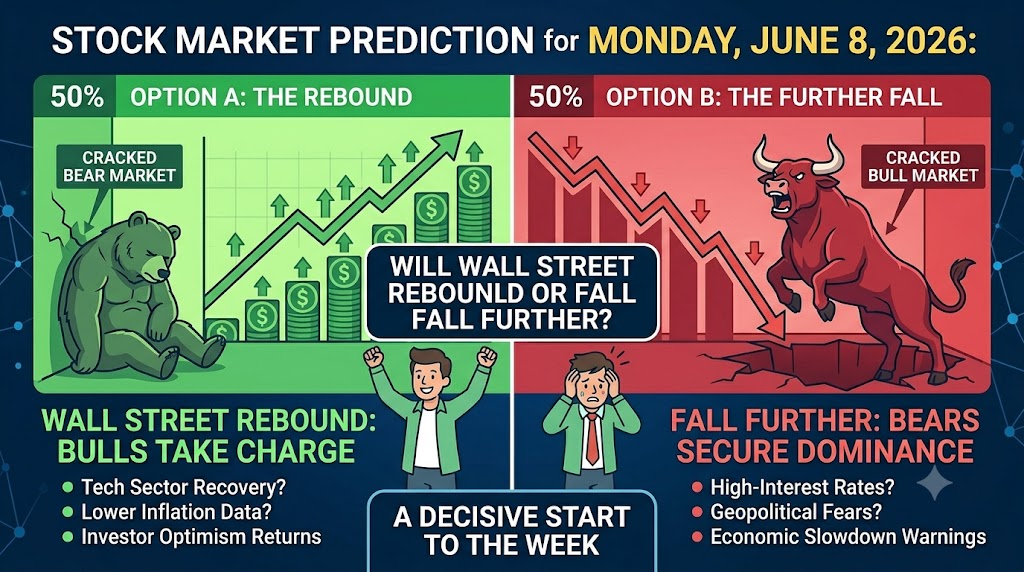
The best stock market prediction for Monday June 8 2026 is not one blind call. A smart market outlook uses scenarios because the market can change quickly after the opening bell. Friday created fear, but Monday will reveal whether big investors see the dip as a buying opportunity or a warning sign.
Bullish Rebound Scenario
The bullish scenario is a relief bounce. This could happen if bond yields calm down, semiconductor stocks stop falling, and traders decide Friday’s move was an overreaction. In this case, the S&P 500 may try to move back toward 7,450–7,500, while QQQ may attempt to recover toward $720–$735. A bounce would become stronger if market breadth improves and more sectors participate.
This scenario is possible because sharp Friday sell-offs sometimes create Monday dip-buying, especially when long-term investors believe the economy is still strong. But the bounce must be watched carefully. A weak bounce on low volume may only be a pause before another decline.
Bearish Continuation Scenario
The bearish scenario is a follow-through sell-off. This could happen if Treasury yields rise again, Fed rate-hike fears increase, or chip stocks continue falling. The VIX jumped sharply to around 21.51 on June 5, showing that volatility expectations rose quickly after the sell-off.
If the S&P 500 breaks below 7,300, the market may target lower support zones. If QQQ breaks below $700, tech weakness could accelerate. This would make Monday a risk-off session where investors prefer cash, defensive stocks, bonds, or lower-beta sectors.
Sideways Volatile Scenario
The third scenario is sideways volatility. This may be the most realistic if traders are unsure after Friday’s shock. The market could open lower, bounce, fall again, and close mixed. That type of session is frustrating because both bulls and bears feel trapped. For beginners, this is where overtrading becomes dangerous.
A sideways volatile Monday would mean investors are waiting for more clarity from bond yields, Fed expectations, and upcoming inflation data. Since MarketWatch’s economic calendar showed no major U.S. economic reports scheduled for June 8, the market may trade mostly on Friday’s aftershock, positioning, and Fed-rate expectations.
What Could Move the Market on June 8, 2026
The first big market mover will be bond yields. Friday’s sell-off was linked to rising yields after stronger jobs data. When yields rise, stocks—especially growth stocks—often come under pressure. If yields cool on Monday, buyers may step back in. If yields rise again, selling pressure may continue.
The second market mover will be Fed expectations. Traders are not only thinking about the June Fed meeting. They are also thinking about the rest of 2026. Reuters reported that futures markets lifted rate-hike odds after the jobs report, which means investors are now questioning whether the Fed may become more hawkish later this year.
The third market mover will be AI and semiconductor stocks. If Nvidia, AMD, Broadcom, Intel, and other chip names recover, the Nasdaq may bounce. If they continue falling, Monday could stay red. This is why traders should not only watch the S&P 500 headline number. They should also watch market leadership.
Trading and Investing Strategy for Monday
For short-term traders, Monday is not a day to trade emotionally. The market may be fast, noisy, and full of fake moves. A strong open does not guarantee a bullish day, and a weak open does not guarantee a crash. Traders should watch the first 30–60 minutes, volume, price action near support, and whether the market can hold above key levels.
For long-term investors, Monday’s decline may be less about prediction and more about discipline. If your investment plan is based on long-term goals, one volatile Monday should not force panic decisions. But it can be a good time to review portfolio risk. If your portfolio is overloaded with high-growth AI stocks, Friday’s move is a reminder that even strong themes can fall sharply when expectations become too hot.
Final Market Outlook
My base-case stock market prediction for Monday June 8 2026 is: volatile opening, cautious sentiment, and a possible relief bounce only if tech stocks stabilize and bond yields cool. The market is not giving a clean bullish signal right now. Friday’s selling was too broad and too sharp to ignore. The Nasdaq looks especially vulnerable because AI and semiconductor stocks are under pressure.
The S&P 500 may attempt to hold the 7,300–7,350 zone. If that support holds, a bounce toward 7,450–7,500 is possible. If that support breaks, sellers may push the market lower. The Dow may remain relatively stronger than the Nasdaq if investors continue rotating into defensive or value-oriented names.
Conclusion
The stock market prediction for Monday June 8 2026 is not a simple “market will go up” or “market will go down” call. The better answer is that Monday may be a high-volatility session after Friday’s sharp tech-led sell-off. Strong jobs data changed interest-rate expectations, bond yields moved higher, and AI stocks finally showed weakness after a powerful rally. That combination makes Monday important.
For traders, patience is better than guessing. Watch the S&P 500 near 7,300–7,350, QQQ near $700–$705, and the VIX near the low-20s. For investors, the key is not panic. A correction after a strong rally can be normal, but risk management matters. Monday’s market will likely tell us whether Friday was just a one-day reset or the beginning of a deeper June pullback.
FAQs
1. Will the stock market go up on Monday, June 8, 2026?
The market may attempt a relief bounce if bond yields cool and tech stocks stabilize. However, after Friday’s sharp sell-off, the overall Monday outlook is cautious and volatile.
2. Why did the Nasdaq fall so much on Friday?
The Nasdaq fell sharply because AI, semiconductor, and high-growth technology stocks sold off after strong jobs data increased fears of higher interest rates. Higher rates usually hurt growth stocks more than defensive stocks.
3. What is the key S&P 500 level to watch on Monday?
The key support zone for the S&P 500 is around 7,300–7,350. If the index holds this area, a rebound is possible. If it breaks below this zone, bearish pressure may increase.
4. Is Monday a good day to buy stocks?
Monday may offer opportunities, but it also carries higher risk. Long-term investors can consider gradual buying only if it fits their plan, while short-term traders should wait for confirmation instead of chasing the first move.
5. What should beginners do before the market opens Monday?
Beginners should avoid emotional trades, check pre-market futures, watch bond yields, follow major tech stocks, and use stop-loss rules if trading. For investing, they should focus on long-term allocation instead of reacting to one bad market day.

“Hi, I am Devel Gupta, an entrepreneur and the founder of FinanceWithDevel. With 10 years of experience in teaching and simplifying personal finance, my mission is to help beginners build long-term wealth without the confusing jargon. Whether it’s budgeting, investing, or retirement planning, I believe financial freedom starts with simple, consistent habits. Let’s make money make sense. Connect with me on [ LinkedIn/Twitter ] for more daily tips!”