Gold is not just a metal in India. It is emotion, security, culture, wedding tradition, family wealth, and investment all packed into one shiny asset. For many investors, gold is also one of the most popular alternative assets like gold because it can help protect wealth during uncertain times.
in 2026, many buyers are asking the same question: Why Is Gold So Expensive in India when international prices already look high?
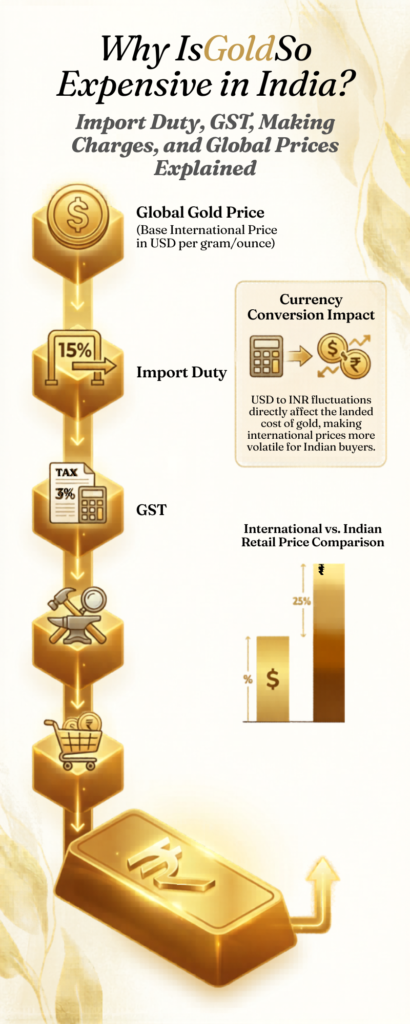
The answer is simple on the surface but deep in reality. Gold becomes expensive in India because the final jewellery price includes global gold rates, rupee-dollar movement, import duty, GST, making charges, wastage, hallmarking, jeweller margin, and local market demand. As of May 22, 2026, 24K gold in India was quoted around ₹15,994 per gram, while 22K gold was around ₹14,661 per gram, according to market-rate data cited by Bajaj Broking.
Why Is Gold So Expensive in India: The Simple Answer
The short answer to Why Is Gold So Expensive in India is this: India imports a large part of the gold it consumes, so the country must buy gold at global prices, pay in dollars, convert that cost into rupees, and then add taxes and retail charges.
India does not produce enough gold domestically to meet jewellery, investment, and cultural demand. So when global prices rise, Indian prices rise. When the rupee weakens against the dollar, Indian prices rise again. When the government increases import duty, the landed cost rises further. After that, jewellery buyers pay GST and making charges.
This is why a gold chain is never priced only by the raw gold rate. The final bill is a layered price.
Why Is Gold So Expensive in India in 2026?
The biggest 2026 reason behind Why Is Gold So Expensive in India is the sharp rise in import duty. India raised import tariffs on gold and silver from 6% to 15% in May 2026 to curb overseas purchases and reduce pressure on foreign exchange reserves.
World Gold Council also reported that the gold import duty was raised sharply from 6% to 15%, calling it the steepest increase on record and a reversal of the July 2024 duty cut.
This matters because import duty directly affects the landed price of gold. For example, if imported gold is worth ₹1,00,000 before duty, a 6% duty added ₹6,000. At 15%, the duty becomes ₹15,000. That is ₹9,000 extra even before GST, making charges, and retail margins.
Why Is Gold So Expensive in India Compared to Global Prices?
A common mistake is comparing the international gold price with Indian jewellery prices directly. But Why Is Gold So Expensive in India compared with global prices? Because India’s retail gold price is not just the international bullion price.
The global price is usually quoted in dollars per troy ounce. Indian buyers pay in rupees per gram or per 10 grams. So the conversion includes:
- International gold price
- Dollar-to-rupee exchange rate
- Import duty
- GST
- Refining and logistics cost
- Jeweller margin
- Making charges
- Hallmarking and purity-related costs
World Gold Council said India’s domestic gold price rose sharply in Q1 2026, with MCX spot gold averaging ₹151,108 per 10 grams, up 20% quarter-on-quarter and 81% year-on-year. It also noted that domestic prices outpaced international gains because of rupee weakness.
Import Duty: A Big Reason Gold Costs More
One major answer to Why Is Gold So Expensive in India is import duty. Since India imports a huge quantity of gold, the government uses customs duty to control imports, manage the current account deficit, protect foreign exchange reserves, and regulate demand.
In 2024, the government had reduced gold customs duty from 15% to 6%, which temporarily reduced the tax burden on imported gold. World Gold Council described that 2024 cut as the sharpest reduction on record and the lowest duty level since June 2013.
But in May 2026, the duty moved back to 15%. That means buyers again face a higher tax-loaded price. Even if the global price does not move, the domestic price can rise because the import tax has increased.
GST on Gold: What Buyers Actually Pay
Another important part of Why Is Gold So Expensive in India is GST. Many people think GST is charged only on the gold value, while some think making charges are always taxed separately. The actual treatment depends on the type of transaction.
For normal retail jewellery sold to an end customer, CBIC’s sectoral FAQ says GST is payable at 3% on the total transaction value of jewellery, whether making charges are shown separately or not.
This means if your gold jewellery bill includes gold value plus making charges, GST is generally calculated on the full transaction value at 3%. However, job-work services in the jewellery industry may have separate GST treatment, so buyers should always check the final invoice.
Making Charges: The Hidden Price Booster
When someone asks Why Is Gold So Expensive in India, they usually think only about taxes. But making charges can also make a big difference.
Making charges are the labour and design charges added by the jeweller. They can be fixed per gram or charged as a percentage of the gold value. Simple machine-made jewellery may have lower making charges, while handmade, designer, bridal, antique, temple, kundan, or heavy-detail jewellery may have much higher charges.
For example:
| Item | Approximate Cost |
|---|---|
| 10g 22K gold value at ₹14,661/g | ₹1,46,610 |
| Making charge at 12% | ₹17,593 |
| Subtotal | ₹1,64,203 |
| GST at 3% | ₹4,926 |
| Final approximate bill | ₹1,69,129 |
So, even though the gold value is ₹1,46,610, the final jewellery bill becomes close to ₹1,69,129. This is why jewellery feels much more expensive than the daily gold rate shown online.
Why Is Gold So Expensive in India During Wedding Season?
Demand is another answer to Why Is Gold So Expensive in India. In India, gold buying is not only investment-driven. It is also linked to weddings, Akshaya Tritiya, Dhanteras, Diwali, family functions, and gifting traditions.
During wedding season, demand for jewellery rises. Jewellers stock more inventory. Consumers buy heavier designs. Families often buy gold even when prices are high because the purchase is linked to tradition, not only return on investment.
When demand stays strong during high-price periods, retailers do not need to reduce margins aggressively. That keeps jewellery prices firm.
Rupee Weakness Makes Gold Costlier
A powerful reason behind Why Is Gold So Expensive in India is the rupee-dollar exchange rate. Global gold is priced in dollars. India buys imported gold by paying in dollars. So when the rupee weakens, India has to pay more rupees for the same quantity of gold.
For example, suppose international gold is $4,500 per ounce. If $1 equals ₹80, the rupee cost is lower than if $1 equals ₹85 or ₹90. Even if the global gold price stays flat, a weaker rupee can increase the Indian gold price.
That is why Indian gold prices can rise faster than global prices. World Gold Council specifically noted that domestic gold prices in Q1 2026 outpaced international gains partly because of INR weakness.
Global Prices: The Base Layer of Indian Gold Rates
To understand Why Is Gold So Expensive in India, you must first understand global prices. Gold is a global commodity. Its price moves based on inflation expectations, interest rates, central bank buying, geopolitical tension, dollar strength, ETF flows, and investor demand.
When investors fear inflation, recession, war, currency risk, or banking stress, many shift toward gold as a safe-haven asset. That increases global demand and pushes prices higher.
World Gold Council reported that total gold demand, including OTC, topped 5,000 tonnes in 2025, with investment demand playing a major role during a year with multiple all-time highs in gold prices.
So India is not creating the entire price rise alone. Indian buyers are also paying for global fear, global liquidity, global investor demand, and global central bank activity.
Why Is Gold So Expensive in India Even When Demand Is Weak?
This sounds confusing, but Why Is Gold So Expensive in India even when jewellery demand looks weak? Because gold prices are not decided only by local jewellery demand.
If global gold prices are high, import duty is high, and the rupee is weak, Indian prices can stay high even if local buyers slow down. Sometimes jewellers may offer discounts on local market premiums, but that does not always reduce the full retail price meaningfully.
Reuters reported in May 2026 that India’s gold demand remained subdued because of price volatility, while dealers were offering discounts due to weak buying. The same report also linked the market situation to the import duty hike from 6% to 15%.
So local demand can be weak, but the tax and global price structure may still keep gold expensive.
Jewellery Price vs Gold Rate: Understand the Difference
A key part of Why Is Gold So Expensive in India is the gap between gold rate and jewellery rate.
The gold rate tells you the value of raw gold based on purity. Jewellery price includes more components:
- Gold weight
- Purity level, such as 24K, 22K, or 18K
- Making charges
- Wastage charges, if applicable
- GST
- Hallmarking charge
- Stone value, if any
- Brand premium
- Jeweller margin
So if you see 22K gold at ₹14,661 per gram, it does not mean a 10g ornament will cost exactly ₹1,46,610. Your final bill can be much higher depending on design and making charges.
Why 22K Jewellery Costs Less Than 24K Gold
When people search Why Is Gold So Expensive in India, they often compare 24K and 22K prices. 24K gold is almost pure gold, usually 99.9% purity. It is mainly used for coins, bars, and investment products. But it is too soft for most jewellery.
22K gold contains around 91.6% gold and the remaining portion is other metals added for strength. That is why 22K jewellery is cheaper per gram than 24K gold, but the final ornament can still become expensive after making charges and GST.
18K gold contains 75% gold and is often used in diamond jewellery because it is stronger. It has a lower gold value but may carry high design, stone, and brand costs.
Why Is Gold So Expensive in India for Bridal Jewellery?
Bridal jewellery gives another practical answer to Why Is Gold So Expensive in India. Bridal pieces are usually heavier, more detailed, and more labour-intensive. They may include antique finishing, meenakari, kundan, polki, temple design, handmade work, or custom craftsmanship.
A simple gold chain may have lower making charges, but a bridal necklace can have much higher making charges because of design complexity. Even if two ornaments have the same gold weight, their final prices can differ widely.
This is why buyers should always compare:
- Gold rate
- Net weight
- Gross weight
- Stone weight
- Making charge percentage
- Wastage charge
- GST
- Buyback terms
Never compare only the final price. Compare the structure of the bill.
Hallmarking and Purity Also Affect Price
Another answer to Why Is Gold So Expensive in India is purity assurance. Hallmarked jewellery gives buyers better confidence about purity. Hallmarking itself is not the biggest cost, but certified purity, brand trust, exchange policies, and billing transparency can increase the overall retail price.
A trusted jeweller may charge more than an unknown seller, but the buyer gets better documentation, purity assurance, and resale support. In gold, trust has a price.
Brand Premium: Why Big Jewellers Charge More
When people ask Why Is Gold So Expensive in India, they often compare local jewellers with branded jewellery chains. Big brands may charge higher making charges or design premiums because they spend on showrooms, staff, advertising, certification, inventory, insurance, and buyback systems.
A local jeweller may offer lower making charges, but buyers must check hallmarking, purity, invoice quality, exchange policy, and transparency. A lower price is good only if purity and billing are genuine.
Why Is Gold So Expensive in India Despite Old Family Gold?
India has a lot of privately held household gold, but Why Is Gold So Expensive in India if families already own gold? Because old household gold does not automatically enter the market.
Most families do not sell gold unless there is a financial need. Gold is emotionally held across generations. This limits recycled supply. When new demand rises, the market still needs imported gold.
Recycled gold helps, but it cannot fully replace fresh imports. This keeps India dependent on global supply and import policy.
How Taxes Change the Buyer’s Final Price
Let’s understand Why Is Gold So Expensive in India with a simple cost chain.
Assume raw imported gold value is ₹1,00,000.
| Cost Component | Approximate Impact |
|---|---|
| Base imported gold value | ₹1,00,000 |
| Import duty at 15% | ₹15,000 |
| Landed cost before retail layer | ₹1,15,000 |
| Making charges, assume 10% | ₹11,500 |
| Subtotal | ₹1,26,500 |
| GST at 3% | ₹3,795 |
| Approximate final price | ₹1,30,295 |
This example is simplified, but it shows the logic. The buyer may start by thinking gold is worth ₹1,00,000, but after duty, making charges, and GST, the final price can move far above that.
Gold Coins vs Jewellery: Which Is More Expensive?
For investors asking Why Is Gold So Expensive in India, the answer differs between jewellery and investment gold.
Gold coins and bars usually have lower making or minting charges than jewellery. Jewellery carries design and labour costs, so it is less efficient as a pure investment. If your purpose is investment, sovereign gold bonds, gold ETFs, gold mutual funds, or digital gold alternatives may be worth comparing, depending on your risk profile and tax situation.
But if your purpose is wedding, gifting, or wearing, jewellery has emotional value. Just remember that emotional value and investment value are not the same thing.
How to Reduce Gold Buying Cost in India
Once you understand Why Is Gold So Expensive in India, you can reduce avoidable costs.
Here are practical tips:
- Buy hallmarked jewellery only.
- Compare making charges across jewellers.
- Avoid very high-wastage designs unless you truly want them.
- Ask for a full tax invoice.
- Check net weight and stone weight separately.
- Avoid paying gold price for stones, beads, or non-gold material.
- Compare 22K and 18K depending on use.
- Buy during low-demand periods if possible.
- For investment, compare coins, ETFs, and SGB-like options if available.
- Always check buyback and exchange rules before purchase.
The easiest saving is usually in making charges, not in the gold rate. You cannot control global prices or import duty, but you can negotiate making charges.
Why Is Gold So Expensive in India: Buyer Checklist
Before buying, use this checklist to understand Why Is Gold So Expensive in India on your own bill:
- What is today’s gold rate?
- Is the rate for 24K, 22K, or 18K?
- What is the net gold weight?
- What is the making charge?
- Is making charge fixed or percentage-based?
- Is there any wastage charge?
- Is GST shown clearly?
- Is the jewellery hallmarked?
- Are stones billed separately?
- What is the exchange or buyback deduction?
A transparent bill is your best protection.
Suggested External Links for Your Blog
You can add these external links naturally in your WordPress article:
- Link “World Gold Council” in the paragraph about global gold demand.
- Link “CBIC GST sectoral FAQ” in the paragraph explaining GST on gold jewellery.
- Link “Reuters report on India’s gold import tariff” in the paragraph about the 2026 import duty hike.
- Link “daily gold price data” in the paragraph where you mention 24K and 22K gold rates.
These links will make your blog more trustworthy for readers and search engines.
Conclusion: Why Is Gold So Expensive in India?
So, Why Is Gold So Expensive in India? Because Indian gold prices are built layer by layer. The base is the global gold price. Then comes the rupee-dollar exchange rate. Then comes import duty. Then GST. Then making charges, hallmarking, jeweller margin, design premium, and local demand.
In 2026, the answer became even clearer after India raised gold import duty from 6% to 15%. That single policy change increased the landed cost of imported gold and made retail jewellery even more expensive for buyers. Add high global prices, rupee weakness, wedding demand, and making charges, and the final price becomes much higher than the raw gold rate.
Gold may remain expensive in India, but smart buyers can still protect themselves by comparing making charges, checking hallmarking, reading the invoice carefully, and choosing the right form of gold for their purpose.

“Hi, I am Devel Gupta, an entrepreneur and the founder of FinanceWithDevel. With 10 years of experience in teaching and simplifying personal finance, my mission is to help beginners build long-term wealth without the confusing jargon. Whether it’s budgeting, investing, or retirement planning, I believe financial freedom starts with simple, consistent habits. Let’s make money make sense. Connect with me on [ LinkedIn/Twitter ] for more daily tips!”