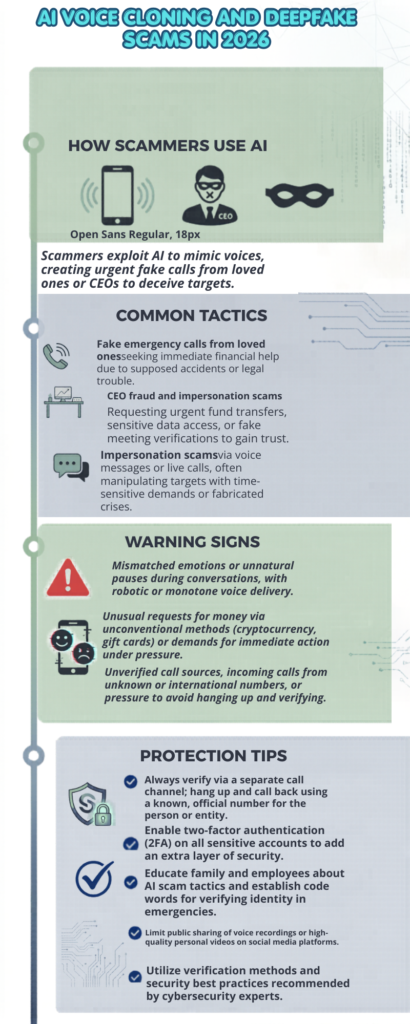
AI voice cloning and deepfake scams are no longer strange internet stories that happen to “someone else.” In 2026, they are becoming one of the most personal forms of fraud because they attack the people and voices we trust. A scammer does not need to break into your home or steal your wallet first; they can make a phone call that sounds like your child, your parent, your boss, or your bank. That is what makes this threat so dangerous. It turns normal human emotions—love, fear, urgency, and trust—into a shortcut for stealing money.
The scary part is that the fake does not always need to be perfect. It only has to sound believable at the exact moment your emotions are running high. When a voice says, “I need help right now,” many people react before they think. That is not weakness; that is human nature. But because AI voice cloning and deepfake scams are designed to hijack that reaction, you need simple rules prepared before the emergency call, fake video, or suspicious message ever reaches you.
The numbers show why this topic matters. The FTC said consumers filed 3 million fraud reports in 2025 and reported $15.9 billion in losses. Imposter scams were the most reported category, with more than 1 million reports and over $3.5 billion in losses, while investment scams caused $7.9 billion in losses. The FBI also reported that cyber-enabled crimes cost Americans nearly $21 billion in 2025, and AI-related complaints alone caused nearly $893 million in losses. These figures make one thing clear: AI voice cloning and deepfake scams are not just a tech problem; they are a money problem, a family problem, and a daily safety problem.
What Are AI Voice Cloning and Deepfake Scams?
AI voice cloning and deepfake scams happen when criminals use artificial intelligence to copy a real voice, face, or identity and use it to trick people. Voice cloning can turn a short audio sample into a fake message or phone call. Deepfake technology can create realistic-looking videos of people saying or doing things they never actually said or did. A scammer may pretend to be a family member in trouble, a bank employee warning about fraud, a CEO ordering a wire transfer, or a famous investor promoting a “limited-time” opportunity.
The FTC has warned that scammers can use a short audio clip from online content to clone the voice of a loved one and make a family emergency scam sound real. The FTC also advises people not to trust the voice alone and to verify the story by calling the person back on a phone number they already know. That advice sounds simple, but it is powerful because it breaks the scammer’s control over the situation. If the caller is real, verification will not hurt. If the caller is fake, verification can save your money.
AI voice cloning and deepfake scams are especially effective because they combine technology with psychology. The technology creates the fake voice or face. The psychology creates the pressure. Scammers know that people are more likely to make mistakes when they feel scared, rushed, embarrassed, or hopeful. That is why these scams often include phrases like “do not tell anyone,” “send money immediately,” “your account will be locked,” or “this opportunity closes today.”
Why These Scams Are Growing in 2026
AI voice cloning and deepfake scams are growing because the tools are easier to access, cheaper to use, and more convincing than before. In the past, creating realistic fake media required advanced skills and expensive software. Now, criminals can use online tools, stolen personal data, public social media clips, and automated scripts to create scams at scale. They can target thousands of people while making each message feel personal. That is a nasty combination.
The FBI’s 2025 Internet Crime Report included artificial intelligence as a dedicated section for the first time, showing 22,364 AI-related complaints and nearly $893 million in adjusted losses. The FBI also warned that scammers use fake social profiles, voice clones, identification documents, and believable videos of public figures or loved ones. This matters because many victims are not falling for “bad grammar” scams anymore. They are falling for scams that look polished, sound emotional, and arrive through familiar platforms.
Another reason AI voice cloning and deepfake scams are increasing is social media. People post birthday videos, school events, travel updates, family reels, work achievements, and public comments without thinking about how much information they reveal. A scammer can learn relationships, names, locations, job roles, family routines, and speaking patterns. That information helps them create a scam that feels custom-made. The more personal the scam feels, the more dangerous it becomes.
Common Types of AI Voice Cloning and Deepfake Scams
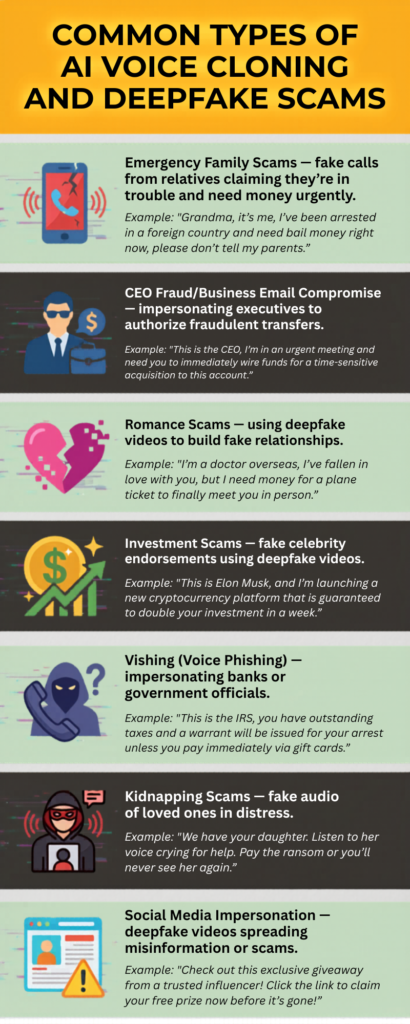
AI voice cloning and deepfake scams usually appear in a few common forms. The first is the family emergency scam. You receive a call from someone who sounds like your son, daughter, spouse, grandchild, or parent. They say they had an accident, got arrested, lost their phone, or need urgent help. Then another person may join the call pretending to be a lawyer, police officer, doctor, or friend. The goal is to make you send money before you verify anything.
The second common type is the fake bank or government call. A person claims your account has suspicious activity, your Social Security number is involved in a case, or your money must be moved to a “safe account.” Real banks and government agencies do not pressure you to transfer money urgently, reveal one-time passcodes, buy gift cards, or send crypto. If someone does that, treat it as a red warning sign. Hang up and contact the official number from your bank card, banking app, or government website.
The third type is the deepfake investment scam. A fake video may show a celebrity, business leader, financial expert, or news anchor promoting crypto, AI trading software, or a secret investment platform. The video may look convincing, but the offer usually includes urgency, guaranteed returns, and pressure to deposit money fast. The FTC reported that investment scams caused the highest consumer losses in 2025, reaching $7.9 billion. So if an online investment video looks exciting but pushes instant action, step back before you click.
Warning Signs You Should Never Ignore
AI voice cloning and deepfake scams often carry the same warning signs, even when the voice or video looks real. The biggest warning sign is pressure. Scammers do not want you to pause, call someone else, check official sources, or sleep on the decision. They want action now. If someone demands urgent money and says you must keep it secret, that is not a normal emergency; that is a classic scam pattern.
Another warning sign is an unusual payment method. Scammers love wire transfers, cryptocurrency, gift cards, payment apps, and bank transfers because these payments can be hard to reverse. If a caller says, “Do not call the bank,” “do not tell your family,” or “send it through this wallet address,” you should stop immediately. A real family member, bank, or employer will understand safety checks. Only a scammer gets angry when you verify.
These scams may also include tiny details that feel off. The voice may sound emotional but avoid specific personal answers. The video may have strange lip movement, unnatural blinking, odd lighting, or robotic pauses. The message may come from a new number, a fresh social profile, or a strange email address. But do not rely only on spotting technical flaws. The safest rule is simpler: verify every urgent money request through a separate trusted channel.
5 Smart Ways to Protect Your Money
AI voice cloning and deepfake scams can be fought with practical habits, not panic. The first smart step is to create a family safe word. Choose a private phrase that is not connected to birthdays, pets, addresses, schools, or anything visible online. Tell your family that if anyone asks for emergency money, the safe word must be used. No safe word, no transfer. It may feel old-fashioned, but it works because it gives your family a quick fraud filter.
The second step is to verify through a second channel. If someone calls and asks for money, hang up and call the person back using a saved number. If it is your bank, use the official app or the number on the back of your card. If it is your boss, confirm through company-approved communication. The FTC recommends calling the person who supposedly contacted you using a known number and contacting another family member or friend if you cannot reach them. That one extra step can break the scam.
The third step is to slow down every urgent request. The FBI tells people to “Take a Beat” before giving money or personal information. This is important because AI voice cloning and deepfake scams are built around speed. Make a personal rule that you will never transfer money, share passwords, reveal one-time passcodes, or move funds based only on one call, video, message, or email. A pause is not rude; it is protection.
The fourth step is to reduce the information scammers can collect. Keep personal accounts private, avoid posting too much family information, limit public voice and video clips, and be careful with workplace details online. For small businesses, payment approvals should never depend only on a phone call or voice message. Create a rule that vendor changes, wire transfers, payroll updates, and urgent payments require written confirmation and at least one additional approval.
The fifth step is to report and limit damage fast. If you think you were targeted, contact your bank, card company, payment app, or crypto platform immediately. Ask whether the payment can be stopped, reversed, frozen, or flagged. Change passwords, turn on multi-factor authentication, and watch your accounts closely. You should also report fraud to the FTC and cybercrime complaints to the FBI’s IC3. Quick reporting may not guarantee recovery, but it improves your chances and helps authorities track scam patterns.
What To Do If You Already Sent Money
If AI voice cloning and deepfake scams have already cost you money, act quickly and do not waste time feeling embarrassed. These scams are designed to fool careful people, not just careless people. Call your bank or payment provider and clearly say you were scammed. Ask for a fraud case number. Save screenshots, phone numbers, emails, wallet addresses, bank details, social media links, and any messages connected to the scam.
Then report it to the right places. The FBI recommends documenting the scammer or company name, contact methods, dates, payment methods, where the funds were sent, and a full description of what happened. You should also warn close family, coworkers, and friends, especially if the scammer used your name, voice, photo, or account. Fraud often spreads like a chain reaction. One fast warning from you can stop someone else from becoming the next victim.
How Families and Small Businesses Can Stay Safer
This kind of fraud affects families and businesses differently, but the solution is similar: create rules before emotions take over. Families should talk openly about safe words, emergency verification, and payment limits. Older adults should be reminded that it is okay to hang up, call back, and ask questions. Teenagers and young adults should understand that public videos and voice clips can be misused. Everyone should know that real emergencies can survive a two-minute verification check.
Small businesses need stronger payment controls because scammers often impersonate executives, vendors, or employees. A fake CEO voice message can tell an employee to wire money immediately. A fake vendor email can request a bank account change. A fake video meeting can make a fraudulent instruction look official. To reduce risk, businesses should require dual approval for unusual payments, confirm bank detail changes through a known contact, and train employees to challenge urgent requests without fear.
Conclusion
AI voice cloning and deepfake scams are dangerous because they feel personal, urgent, and believable. They use familiar voices, realistic videos, and emotional pressure to make people act before they think. But you are not helpless. A family safe word, second-channel verification, slower decisions, better privacy settings, and fast reporting can protect your money from scams that look and sound real.
The golden rule is simple: pause before you pay. If a call, video, or message asks for money urgently, secretly, or through an unusual payment method, stop and verify. AI can copy a voice, but it cannot beat a family rule, a second phone call, and a calm decision. That is how you stay safer in 2026.
FAQs
1. What are AI voice cloning and deepfake scams?
AI voice cloning and deepfake scams are frauds where criminals use artificial intelligence to copy someone’s voice, face, or identity. They may pretend to be a family member, boss, bank officer, celebrity, or government official to pressure you into sending money or sharing private information.
2. How can I tell if a voice cloning call is fake?
Do not judge only by the voice. Hang up and call the person directly using a saved number. Ask for a family safe word or verify through another trusted person. If the caller demands secrecy, gift cards, crypto, wire transfers, or instant payment, it is likely a scam.
3. Can deepfake videos be used for investment fraud?
Yes. Scammers can create fake videos of celebrities, financial experts, or business leaders promoting fake crypto platforms, trading apps, or investment schemes. If the offer promises guaranteed returns or asks you to invest immediately, avoid it and verify through official sources.
4. Are AI-generated robocalls illegal in the U.S.?
The FCC ruled in February 2024 that calls made with AI-generated voices are considered “artificial” under the Telephone Consumer Protection Act, making many AI voice robocalls illegal when they do not have proper consent. This gives regulators and state attorneys general more tools to act against voice cloning robocall scams.
5. Where should I report a scam?
Report consumer fraud to the FTC and cyber-enabled crime to the FBI’s IC3. Also contact your bank, card company, payment app, or crypto platform immediately if money was sent. The faster you act, the better your chance of limiting damage.
For more simple guides on money safety, online scams, and personal finance, visit our personal finance blog.

“Hi, I am Devel Gupta, an entrepreneur and the founder of FinanceWithDevel. With 10 years of experience in teaching and simplifying personal finance, my mission is to help beginners build long-term wealth without the confusing jargon. Whether it’s budgeting, investing, or retirement planning, I believe financial freedom starts with simple, consistent habits. Let’s make money make sense. Connect with me on [ LinkedIn/Twitter ] for more daily tips!”