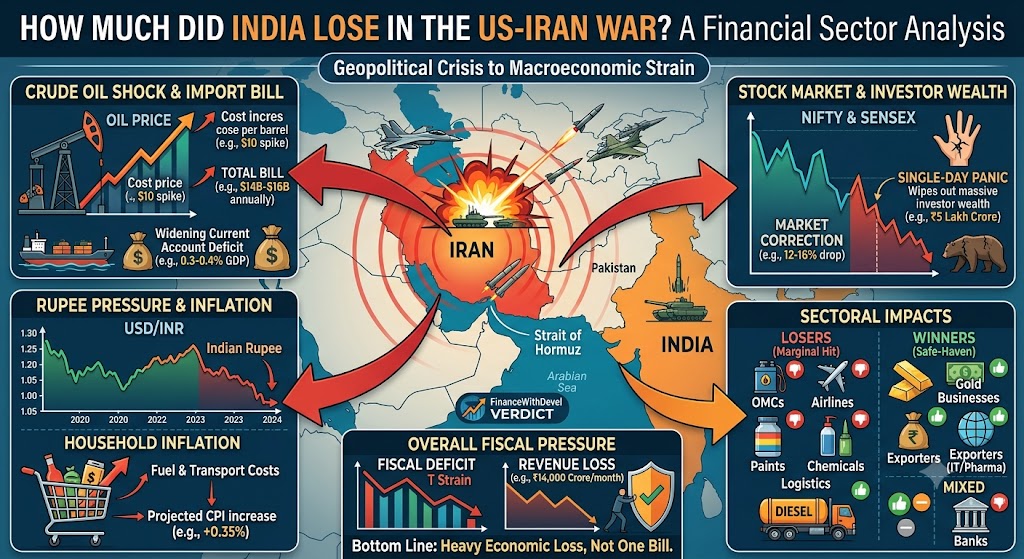
As a major oil importer, India faces a direct impact whenever tensions rise in West Asia and the Strait of Hormuz; oil traders immediately add a risk premium. For India, that is not just a foreign-policy headline. It can become a higher import bill, a weaker rupee, costlier fuel, expensive transport, and nervous stock markets. That is why How Much Did India Lose in the US-Iran War is really a finance-sector question, not just a war question.
Trusted sources such as Reuters, EIA, IEA, PPAC, RBI updates, and market data suggest the damage is measurable across channels, not by a single official rupee figure. In simple words, India did not receive one bill called “war loss.” Instead, the pressure moved through crude oil, currency demand, investor confidence, household inflation, and government finances.
The Numbers That Matter: Hard Data Behind the Loss.
1. The Multiplier Effect (Rule of Thumb)
According to economists and RBI data, every $10 per barrel increase in crude oil prices impacts India’s macroeconomics through these specific channels:
- Import Bill: Widens by approximately $14 Billion to $16 Billion.
- Current Account Deficit (CAD): Worsens by 0.3% to 0.4% of the GDP (around 30–40 basis points).
- Inflation: Triggers a direct increase of 0.30% to 0.35% (30–35 basis points) in CPI inflation.
2. Fiscal Deficit (Pressure on Government Finances)
Research papers and fiscal analysis tracking the crisis suggest:
- Deficit Expansion: An extended conflict could push the government’s additional fiscal deficit up by over ₹74,000 Crore.
- GDP Target Strain: This pressure risks pushing the fiscal deficit target up from its baseline toward 4.49% of GDP (and up to 4.99% in a worst-case scenario).
- Revenue Loss: To shield consumers and keep fuel prices stable, government excise duty cuts or adjustments have resulted in an estimated revenue loss of nearly ₹14,000 Crore per month.
3. Crude Oil & Rupee Data (Record Highs)
- Historic Price Peak: Driven by escalating geopolitical tensions, India’s effective crude basket price has touched record highs near ₹11,200 per barrel when Brent crude spiked between $118–$126 amidst a weakening Rupee.
- Import Bill Spike: Banking and trade reports show that during the peak months of the shock, India’s oil-and-gas import bill jumped by 53% in a single month.
- Balance of Payments (BoP) Deficit: The structural pressure threatened to balloon the BoP deficit from baseline projections up toward $65 Billion, requiring heavy intervention from the RBI to stabilize the currency.
4. Stock Market & Investor Wealth (Dalal Street)
- Market Correction: Driven by global uncertainty, the Nifty corrected heavily, dropping roughly 12% to 16% from its all-time peak of 26,373.
- Single-Day Panic: At the height of the geopolitical escalation, a single volatile trading session wiped out over ₹5 Lakh Crore of investor wealth on paper.
5. Growth and Inflation Re-estimates (RBI & Bank Figures)
- GDP Growth Slowdown: Due to the macroeconomic headwinds, growth forecasts for the financial year were revised downward from a strong 7.7% to a more conservative 6.6%.
- Inflationary Jump: While retail inflation hovered comfortably around 3.48% before the shock, the fuel and commodity disruption pushed the projected average up to 5.1% for the fiscal year.
India’s Losses Are Economic, Not Just Direct
A country can lose money from a conflict even without sending troops. If oil rises, India pays more dollars. If dollars become more expensive, the rupee weakens. If fuel and freight rise, food and daily-use goods can become costlier. If inflation rises, interest-rate cuts become harder. This chain explains how much India loses in the US-Iran War better than any dramatic headline.
The key point is balance. India did not have one officially declared total loss, so claiming a specific amount without proof would be misleading. The practical way to understand the hit is to break it into crude import costs, market-cap changes, currency pressure, FII/FPI outflows, inflation-linked household costs, and sector earnings pressure.
Where India Felt the Financial Impact
The table below shows the main pressure points behind How Much Did India Lose in the US-Iran War.
| Impact Area | How It Hurt India | Who Was Affected | Risk Level |
| Crude oil | Raised import-bill risk | Government, refiners, consumers | High |
| Rupee | Increased dollar demand | Importers, borrowers, investors | High |
| Stocks | Triggered Sensex and Nifty volatility | Retail and institutional investors | Medium to High |
| Inflation | Raised fuel and transport cost risk | Households and small businesses | High |
| Foreign flows | Hurt market sentiment | Equities, banks, rupee | Medium |
| Sectors | Pressured margins | Airlines, paints, chemicals, logistics | Medium to High |
| Gold | Increased safe-haven demand | Savers, jewellers, gold funds | Medium |
| Fiscal deficit | Raised subsidy and tax-pressure risk | Government finances | Medium to High |
- Crude Oil Shock and the Import Bill
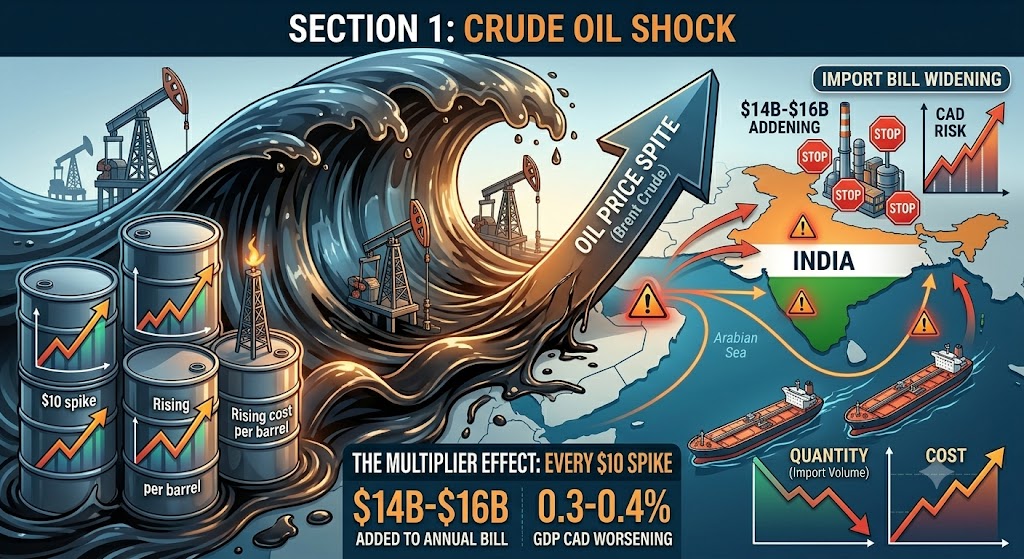
Crude oil is the first place to look when asking How Much Did India Lose in the US-Iran War. India imports most of its oil, so even a small rise in Brent crude can become a large rupee burden. If crude stays high for weeks or months, the extra cost does not hit only oil companies. It travels into transport, refining, fertiliser, chemical, aviation, and household fuel.
For beginners, think of it like a family whose biggest monthly expense suddenly jumps. The family may manage for one month, but if the cost stays high, savings shrink. India faces the same problem at national scale. A higher crude bill can widen the current account deficit and increase demand for dollars. That is why oil is the main transmission channel.
The Forex Equation: Rupee Pressure and Dollar Demand
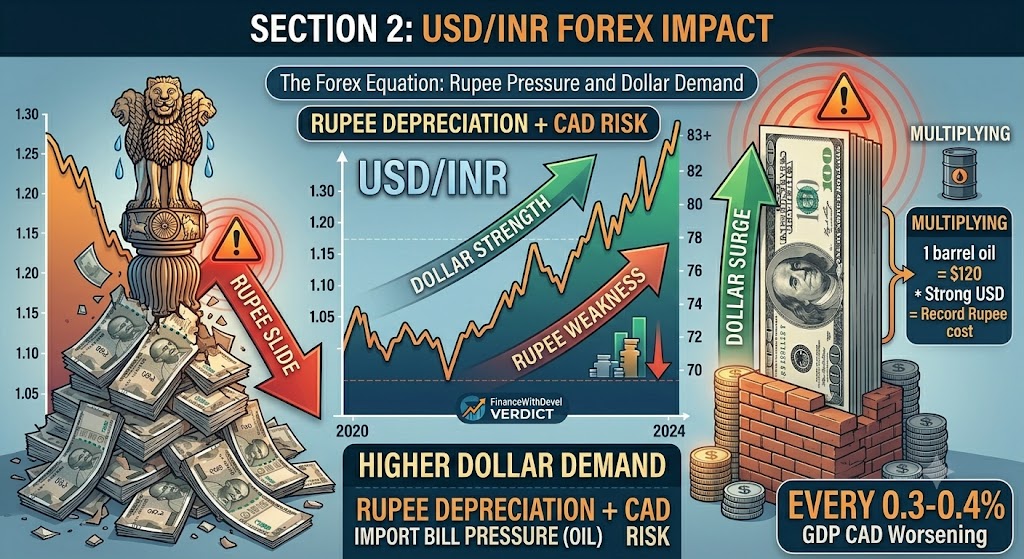
The rupee is the second pressure point in How Much Did India Lose in the US-Iran War. Crude oil is mostly priced in dollars. When oil importers need more dollars, USD demand rises. If the rupee weakens, India pays even more rupees for the same barrel of oil.
This creates a loop. Higher crude raises dollar demand, dollar demand pressures the rupee, and a weaker rupee raises import costs. RBI measures can reduce volatility, but they cannot fully erase a global oil shock. For investors, USD/INR is not just a forex number. It is a live signal for import costs, inflation risk, and corporate margins.
- Dalal Street Reaction: Sensex and Nifty Volatility
Stock markets reacted quickly because investors hate uncertainty. When crude prices rose, or peace hopes faded, Indian equities became shaky. When crude cooled on peace-deal hopes, markets bounced. That is why How Much Did India Lose in the US-Iran War cannot be measured from one red trading session or one green rebound.
Sensex and Nifty volatility matters because falling markets can reduce investor wealth on paper. But market-cap decline is not always a permanent loss. If prices recover, the paper damage reduces. The real risk is panic selling, leveraged trading, and weak companies facing higher costs. Long-term investors should focus on earnings strength, debt levels, and pricing power.
- Inflation Risk From Higher Fuel and Transport Costs
Inflation is where the pressure becomes personal. If fuel costs rise, transport becomes expensive. If transport becomes expensive, food, groceries, construction materials, and deliveries can also cost more. That is why How Much Did India Lose in the US-Iran War is not only a Dalal Street issue. It can enter the monthly budget of a middle-class family.
The government may try to reduce the pain through tax changes, subsidies, or slower fuel-price pass-through. But that only shifts the burden. If consumers do not pay immediately, oil marketing companies or government finances may feel the pressure. In the end, oil shocks usually show up somewhere.
- Foreign Investor Outflows and Market Sentiment
Foreign investors often reduce risk when oil spikes, currency weakens, and earnings visibility falls. That selling can pressure Indian equities and the rupee together. So another piece of How Much Did India Lose in the US-Iran War is FII/FPI outflow and weaker sentiment.
Still, outflows are not always permanent. If oil stabilises and India’s growth remains strong, foreign money can return. That is why investors should not treat every outflow as a vote against India. Sometimes global funds sell simply because they are cutting emerging-market risk.
- Aviation, Paint, Chemicals, Logistics, and OMCs
Sector damage is easier to see than national damage. Airlines suffer when aviation turbine fuel rises. Paint companies face higher crude-linked input costs. Chemical companies can see feedstock and shipping costs rise. Logistics firms feel diesel pressure. Oil marketing companies can suffer if they cannot pass higher costs to consumers. This sector map is central to How Much Did India Lose in the US-Iran War.
| Sector | Outlook | Core Financial Driver |
| Airlines | Negative | Aviation Turbine Fuel (ATF) accounts for nearly 40% of an airline’s operating cost. |
| Paints & Chemicals | Negative | Crude derivatives serve as primary raw materials; margins shrink unless costs are passed to consumers. |
| Logistics & Freight | Negative | Surging diesel prices increase operational overheads for transport fleets. |
| Gold Businesses | Positive | Acts as a safe-haven asset; geopolitical risk drives up domestic gold prices and trading volumes. |
| Exporters (IT/Pharma) | Mixed to Positive | A depreciating rupee boosts realization margins for dollar-earning sectors. |
- Gold Prices and Safe-Haven Buying
Gold usually gets attention during geopolitical stress. Indian households already trust gold, so fear can increase demand. But How Much Did India Lose in the US-Iran War should not push investors into panic buying gold at any price.
Gold can be useful as a portfolio stabiliser. A small allocation through gold ETFs, sovereign gold bonds, or physical gold may help diversify risk. But gold should not replace emergency funds, diversified equity funds, or quality debt. The goal is protection, not emotional buying.
- Government Fiscal Pressure and Subsidy Risk
The government also faces pressure. If it allows fuel prices to rise fully, households feel pain. If it cuts taxes or increases subsidies, revenue and fiscal deficit can feel pain. That is another hidden part of How Much Did India Lose in the US-Iran War.
Fuel taxes, fertiliser subsidies, LPG support, and public-sector oil company profits all matter. If the government spends more to cushion the shock, it may have less room for capital expenditure. That can affect growth later. So the fiscal cost may not be visible immediately, but it can build over time.
Can We Calculate India’s Exact Loss?
No, not honestly, unless official agencies release a full estimate. The correct way to answer How Much Did India Lose in the US-Iran War is to use categories instead of guessing one number.
| Estimated Category | What to Measure |
| Extra crude import cost | Extra dollars paid for oil |
| Market-cap decline | Fall in listed company value |
| Currency impact | Extra rupee cost of imports |
| Household inflation | Higher fuel, food, and transport cost |
| FII/FPI outflows | Foreign selling in stocks and debt |
| Sector earnings pressure | Margin hit in oil-sensitive companies |
A three-week oil spike is different from a six-month crisis. Brent near $90 is different from Brent near $120. A stable rupee is different from a sharply falling rupee. So How Much Did India Lose in the US-Iran War depends on duration, crude price, rupee movement, policy response, and market recovery.
Winners and Losers in India’s Finance Sector
| Group | Winner or Loser? | Why |
| Oil marketing companies | Mostly loser | Cost pressure if prices are not passed on |
| Airlines | Loser | Higher ATF cost |
| Paint companies | Loser | Raw material inflation |
| Banks | Mixed | Macro pressure, but recovery can help |
| Gold businesses | Winner | Safe-haven demand |
| Exporters | Possible winner | Weak rupee supports revenue |
| Import-heavy companies | Loser | Dollar costs rise |
| Retail investors | Mixed | Panic sellers lose; disciplined investors may benefit |
What Retail Investors Should Do
Retail investors should not panic. Panic is expensive. If your SIP is designed for 10 years, a geopolitical shock should not make you stop after 10 days. The real lesson from How Much Did India Lose in the US-Iran War is that diversification matters.
Is it a good time to buy gold? Maybe, but don’t go overboard. It only makes sense if it actually fits into your planned asset allocation.
Do you need to completely dump oil-sensitive stocks? Not necessarily. Just keep an eye on the margin risk—when crude oil prices spike, these companies usually take a direct hit on their profits. Invest with your eyes wide open.
Does it make sense for SIP investors to pause? Generally, no. Unless your income has become unstable or your emergency fund is running dangerously low, your best bet is to keep them running. Staying disciplined through market ups and downs is how you win long-term.
If your goal is to build a safer, well-balanced portfolio, focus on these essentials:
- Solid, diversified equity funds
- A healthy cushion of emergency cash
- Short-duration debt instruments for stability
- A small, limited exposure to gold
- And most importantly: Steer clear of heavy leverage (never invest with borrowed money).
What Indian Households Should Watch
Households should watch petrol, diesel, LPG, grocery bills, school transport, travel costs, and loan EMIs. You may not see a bill named How Much Did India Lose in the US-Iran War, but you may feel the effect when monthly expenses rise.
The best response is simple. Keep 3 to 6 months of emergency savings. Avoid high-interest debt. Do not stop long-term investing without a reason. Review fuel and travel spending. If inflation rises, idle cash loses value, but too little cash can create stress. Balance is the boring hero here.
Our Take: FinanceWithDevel Verdict
- The Bottom Line: India didn’t receive a direct “war bill,” but soaring crude oil prices and a weakening rupee have piled a heavy fiscal pressure of up to ₹14,000 crore per month on the economy.
- For Investors: Avoid stopping your SIPs in a panic. However, stay cautious and keep a close eye on oil-sensitive sectors like paints and airlines.
- For Households: Focus on the basics and ensure you maintain a solid emergency fund covering the next 3 to 6 months of expenses.
Conclusion
India’s loss from the US-Iran conflict cannot be reduced to one dramatic number. The impact was spread across oil imports, currency pressure, stock volatility, inflation risk, foreign investor sentiment, sector margins, and government finances. Some losses may reverse if oil falls and markets recover. Some costs, such as inflation and fiscal pressure, can linger longer.
The smart response is not fear. It is preparation. Investors should stay diversified, avoid leverage, keep SIPs aligned with goals, and review oil-sensitive exposure. Households should protect emergency savings and control avoidable debt. That is the most useful way to understand the finance-sector impact without falling for fake numbers.
You may also like: How Crude Oil Prices Affect the Indian Stock Market.
FAQs
1. How Much Did India Lose in the US-Iran War?
There is no official single figure for How Much Did India Lose in the US-Iran War. The impact must be estimated through crude import costs, rupee depreciation, stock volatility, foreign outflows, inflation pressure, and sector earnings pressure.
2. Did the US-Iran War affect Indian stock markets?
Yes. Sensex and Nifty reacted to crude prices, rupee pressure, foreign flows, and peace-deal expectations. Oil-sensitive sectors were especially volatile.
3. Why does the Iran conflict affect India’s oil prices?
The conflict affects India because the Strait of Hormuz is a major oil transit route, and India depends heavily on imported crude. Any supply-risk premium can raise India’s import bill.
4. Which Indian sectors are most affected by the US-Iran War?
Airlines, paints, chemicals, logistics, oil marketing companies, and import-heavy firms are most affected. Gold-related businesses may benefit from safe-haven demand.
5. Is this a good time to invest in Indian stocks?
It can be, but only for disciplined investors with a long-term plan. Avoid panic buying and panic selling. SIP investors should focus on asset allocation and emergency funds.
6. Can India avoid losses from Middle East conflicts?
India can reduce the impact by diversifying oil suppliers, building reserves, expanding renewables, improving public transport, and managing currency volatility. But it cannot fully avoid the impact while imported energy remains important.
Disclaimer: This article is for educational purposes only and is not financial advice. Readers should consult a certified financial advisor before making investment decisions.

“Hi, I am Devel Gupta, an entrepreneur and the founder of FinanceWithDevel. With 10 years of experience in teaching and simplifying personal finance, my mission is to help beginners build long-term wealth without the confusing jargon. Whether it’s budgeting, investing, or retirement planning, I believe financial freedom starts with simple, consistent habits. Let’s make money make sense. Connect with me on [ LinkedIn/Twitter ] for more daily tips!”