
Have you ever looked at your bank account at the end of the month and felt a sudden wave of panic? You know you earn a decent income, yet your balance seems to vanish into thin air. You aren’t alone. In an era dominated by one-click digital checkouts, hyper-targeted social media advertisements, and seamless mobile payments, our economic environment is engineered to separate us from our hard-earned capital as effortlessly as possible.
The secret to breaking this exhausting cycle of living paycheck to paycheck isn’t about adopting radical deprivation or living on ramen noodles. Instead, it requires mastering a foundational personal finance principle: needs vs wants in budgeting. [1]
After you understand the difference between needs and wants, you can also use the 50/30/20 Budget Rule Explained method to divide your income into needs, wants, and savings in a simple way.
When you learn to look past marketing fluff and clearly distinguish between a true survival necessity and an emotional luxury, your entire relationship with money changes. This comprehensive guide will deeply explore the psychology, hidden traps, and actionable strategies you need to balance your cash flow, stop impulse buying, and dramatically increase your savings rate.
1. Defining the Financial Battleground
To fix your personal finances, you must strip away the emotional justifications surrounding your purchases and view your transactions with absolute clarity. Let’s establish the objective baselines that form the bedrock of successful money management.
The Clear Definition of a Need
A need is an expense that is completely indispensable for your basic survival, physical health, and the maintenance of your baseline employment. If you stop paying for a true need, the consequences are immediate, severe, and potentially dangerous or illegal.
True needs are universally limited to these core categories:
- Housing: Mortgage payments, rent, property taxes, and essential homeowners or renters insurance.
- Basic Utilities: Water, electricity, natural gas, trash collection, and a baseline phone and internet plan (which are mandatory for employment in the modern digital age).
- Nutritional Sustenance: Whole food groceries, water, and essential household hygiene products.
- Healthcare: Medical insurance premiums, life-saving prescriptions, and critical doctor copays.
- Transportation: A modest, reliable vehicle payment, car insurance, fuel, or public transit passes strictly required to commute to work.
- Legal Obligations: Minimum debt payments (credit cards, student loans) and tax liabilities.
The Clear Definition of a Want
A want is any expense that increases your personal comfort, entertainment, convenience, or social status, but is ultimately non-essential for basic human survival or keeping your job. If you completely eliminated all your wants tomorrow, you would be bored and socially isolated, but you would remain safe, housed, and healthy.
For a simple official explanation of needs and wants in budgeting, you can check the CFPB guide on budgeting for needs and wants.
Common wants include:
- Dining Out: Restaurant meals, food delivery apps, specialty coffee runs, and bars.
- Entertainment: Streaming services, concert tickets, sporting events, and video games.
- Leisure Travel: Annual vacations, weekend getaways, and flights to visit family.
- Upgraded Wardrobe: Designer labels, chasing fashion trends, or buying new footwear when your current shoes are fully functional.
- Convenience Upgrades: Ridesharing instead of taking public transit, meal prep subscription kits, and high-end gym memberships.
Understanding needs vs wants in budgeting [2] is often complicated because your baseline shifts depending on your unique life circumstances. A vehicle is an absolute need for an individual living in a rural area with zero infrastructure; that exact same car is an expensive want for someone living in a dense metropolis with an extensive subway network. Recognizing these personal baselines requires strict honesty with yourself.
2. The Dangerous Gray Area: The Upgrading Trap
The primary reason most personal budgets collapse isn’t because people don’t know that a luxury vacation is a want. It’s because consumers routinely disguise their wants as needs by hiding a premium upgrade inside a baseline necessity. This gray area is the exact territory where the battle over needs vs wants in budgeting [3] is won or lost.
Let’s look at how smoothly an essential survival cost can transform into a luxury lifestyle choice:
| The Foundation Need | The Disguised Want (The Upgrade) | The Financial Leak |
| Nutritional Sustenance | Ordering premium artisanal takeout via a delivery app 4 nights a week. | Adds hundreds in inflated food costs, platform service fees, and tips. |
| Reliable Transportation | Financing a brand-new $50,000 sports SUV with an 8% interest rate. | Creates a massive monthly fixed cost that drains your wealth-building potential. |
| Safe, Functional Shelter | Renting a luxury penthouse apartment with a rooftop pool and valet service. | Drastically inflates your overhead, leaving zero margin for an emergency fund. |
| Professional Attire | Purchasing a $700 designer blazer when a modest $90 alternative fits the dress code. | Misallocates capital away from investments to fund short-term social status signaling. |
Learning how to separate emotional upgrades from real needs can improve everyday spending decisions.
When you tell yourself, “I need to eat food to live, therefore this $80 restaurant bill is a need,” you fundamentally sabotage your financial security. If you want to build lasting wealth, you must train yourself to separate the core utility of a purchase from its emotional upgrades. Consistently applying the concept of needs vs wants in budgeting [4] protects you from falling victim to this lifestyle inflation.
3. The Neurobiology of Consumer Spending
Why is separating these categories so difficult for our brains? Humans did not evolve to navigate modern consumer capitalism. Our biology is hardwired for immediate gratification, resource accumulation, and peer status competition.
When you browse online or see a beautifully targeted advertisement, your brain releases a wave of dopamine—the neurotransmitter associated with anticipation and reward. Crucially, dopamine spikes before you make a purchase, during the hunting and imagining phase. The actual transaction provides a brief emotional peak, immediately followed by a rapid crash.
Understanding dopamine and spending behavior can help explain why impulse purchases feel so tempting in the moment.
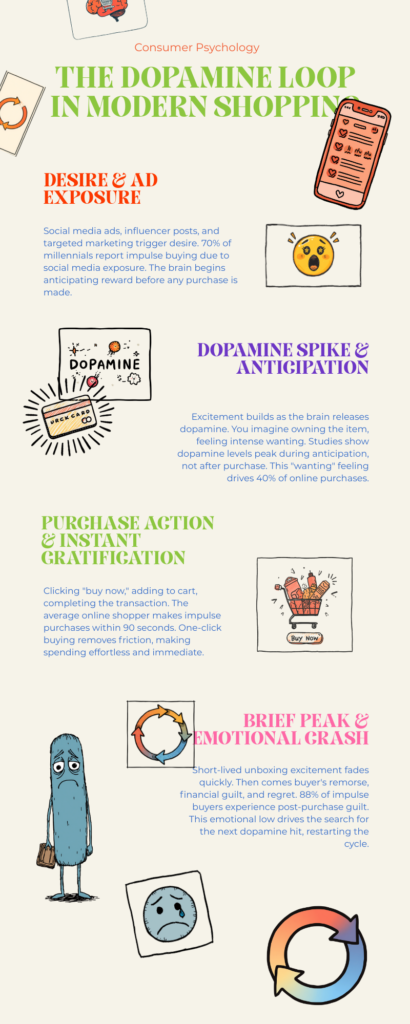
This chemical cycle makes it incredibly easy to mistake an intense, manufactured craving for a survival requirement. Your brain signals a want with the exact same physiological urgency it used to signal a need for food or shelter in the wild.
Furthermore, we are deeply impacted by hedonic adaptation (frequently called the lifestyle treadmill). When you upgrade your lifestyle—such as moving from a modest apartment to a luxury flat, or switching from making home-brewed coffee to purchasing daily cafe lattes—your brain rapidly normalizes this new state as your baseline reality. What used to feel like an exciting luxury suddenly feels like an absolute necessity.
Without a structured approach to needs vs wants in budgeting, [5] your lifestyle spending will naturally expand to consume every dollar of income you ever make, regardless of how many raises, bonuses, or promotions you earn throughout your career.
4. The Structural and Psychological Cost of Confusion
When wants are routinely allowed to masquerade as needs, the damage ripples across every area of your existence. The most immediate impact is structural: your fixed monthly overhead climbs dangerously high, leaving your household highly vulnerable to economic shocks. If 85% of your take-home pay is locked up in rigid bills and lifestyle “needs” that you refuse to downsize, a sudden job loss, medical emergency, or car breakdown instantly transforms into an existential crisis.
Fragile Budget Structure (High Fixed Overhead):
[ Needs + Disguised Wants: 85% ] [ Real Wants: 10% ] [ Savings: 5% ] -> Highly vulnerable to emergencies!

Resilient Budget Structure (Balanced Framework):
[ True Needs: 50% ] [ Intentional Wants: 30% ] [ Savings & Investing: 20% ] -> Built-in financial shock absorbers.
Beyond structural fragility, confusing these categories inflicts a massive opportunity cost on your long-term wealth. Every dollar spent on an unexamined want is a dollar that cannot be invested in compound-interest-bearing assets. Over a 20- or 30-year horizon, a simple $200 monthly category error doesn’t just cost you $200; it costs you tens of thousands of dollars in unearned investment returns that could have funded your retirement.
There is also a profound psychological toll. Constantly living on the edge because your cash flow is bloated creates chronic stress, strains romantic relationships, and fosters a sense of financial helplessness. Organizing your checking accounts around a clear vision of needs vs wants in budgeting [6] is the ultimate antidote to this systemic stress.
5. Strategic Budgeting Frameworks That Work
To systematically manage your cash flow, you need structured frameworks that remove personal bias from decision-making. Let’s look at the two most effective methodologies for organizing your take-home pay.
Framework 1: The 50/30/20 Rule
The 50/30/20 rule is an excellent benchmark for balancing your lifestyle today with your financial security tomorrow. It divides your after-tax income into three distinct buckets:
- 50% for True Needs: Housing, mandatory utilities, basic groceries, insurance, and minimum debt payments.
- 30% for Intentional Wants: Dining out, hobbies, vacations, streaming services, and personal shopping.
- 20% for Savings & Wealth Building: Emergency funds, retirement accounts, and aggressive debt principal paydown.
Beginners can compare this structure with official budgeting resources that explain the 50/30/20 budgeting rule and basic spending categories.
The beauty of this system is its complete lack of judgment. If you are deeply passionate about dining out, you can maximize your 30% wants bucket for restaurants—provided you cut back on other wants, like travel or clothing, to keep the total under the 30% threshold. It allows you to enjoy your life today while guaranteeing that you are protecting your future self. It provides a highly scannable roadmap for executing needs vs wants in budgeting [7] on a monthly basis.
Framework 2: Zero-Based Budgeting
If a percentage-based approach feels too loose for your habits, Zero-Based Budgeting requires you to give every single dollar a specific job before the month begins. Your mathematical equation must look exactly like this:
$$\text{Income} – \text{Expenses} = 0$$
In this system, you map out your true needs first. Once those are fully funded, you allocate money to your savings accounts. Whatever money remains is explicitly divided among your various want categories until your balance hits zero. This framework forces extreme intentionality and prevents your money from quietly evaporating from your checking account. It forces you to actively debate needs vs wants in budgeting [8] before any real-world spending occurs.
6. How to Run a 90-Day Visual Financial Audit
To successfully apply these rules, you must stop guessing what you spend and look at hard, historical data. A visual financial audit illuminates exactly where your money goes and exposes the sneaky wants that have filed themselves under your needs.
Step-by-Step Instructions for Your Audit
If you want to run a complete diagnostic on your spending, follow this exact sequence:
- Gather Your Data: Download the physical bank and credit card statements from the last three full months.
- Color-Code Your Transactions: Grab three different colored highlighters (or use color-coding tools in a spreadsheet).
- Color A (e.g., Green): True Survival Needs.
- Color B (e.g., Yellow): Clear Wants.
- Color C (e.g., Pink): Disguised Wants (Upgrades hidden inside needs).
- Run the Elimination Test: For every transaction, ask yourself: “What would happen if I stopped paying for this next month?” If the answer is “nothing besides minor inconvenience or temporary boredom,” it is a want.
- Calculate Your Real Percentages: Add up the totals for each color and divide them by your total take-home income. Compare your real-world percentages to the 50/30/20 benchmark.
A spending tracker tool can make this audit easier because it helps you record expenses by category.
Regularly performing this exercise reinforces your knowledge of needs vs wants in budgeting, [9] transforming an abstract academic concept into a highly practical daily habit.
7. Actionable Strategies to Control Spending and Save More
Understanding the theory of needs vs wants in budgeting [10] is only half the battle; you also need tactical tools to change your daily behaviors. Here are four high-impact tactics that introduce deliberate friction into your spending environment.
1. Implement the 48-Hour Cooling-Off Rule
Digital storefronts are optimized for impulse buys. To counter this, introduce deliberate friction. When you find an item you want to buy online, add it to a wishlist or write it down on a piece of paper. Force yourself to wait 48 hours before checking out. During those two days, the initial dopamine rush will fade, and your logical brain will realize you don’t actually need it. It is a simple tool to filter needs vs wants in budgeting [11] in real-time.
2. Pay Yourself First (Reverse Budgeting)
Traditional budgeting tells you to pay your bills, spend on your wants, and save whatever is left over at the end of the month. This rarely works because we naturally spend what is available. Instead, automate your savings. The morning your paycheck hits your account, automatically route 20% into a separate high-yield savings or investment account. You are then forced to live on the remaining 80%, keeping your needs vs wants in budgeting [12] allocations naturally balanced.
3. Audit Your Subscriptions (The Phantom Wants)
Subscriptions are dangerous because they convert a one-time want into a permanent, recurring fixed cost. Every streaming service or app membership chips away at your financial margin. Look at your statements from the last 60 days, identify every recurring charge, and cancel any platform you haven’t actively used in the last 14 days. This keeps your automated expenses strictly restricted to true survival obligations.
4. Insert Artificial Friction
The easier it is to pay for an item, the less emotional pain you feel when spending money. To combat this, intentionally reintroduce barriers into your shopping environment. Delete your saved credit card details from online retailers and web browsers. Forcing yourself to manually locate your wallet and type in a 16-digit number gives your brain the time it needs to reconsider the purchase through the lens of your needs vs wants in budgeting [13] goals.
8. The Operational Roadmap Checklist
To help you seamlessly integrate these principles into your life, use this complete operational roadmap. It maps out your journey across short-term setup, medium-term tracking, and long-term habits to ensure your spending aligns perfectly with your wealth goals.
Phase 1: Structural Setup & Definition (Days 1–7)
- [ ] Draft Your Personal Baseline Definitions: Write down exactly what constitutes a true need in your specific geographic location and line of work.
- [ ] Audit Your Housing and Fixed Costs: Calculate your current fixed overhead. Does your total housing consume more than 50% of your take-home income?
- [ ] Separate Bank Accounts: Set up at least two distinct checking accounts—one dedicated exclusively to automated fixed bills (Needs) and one for your variable personal spending (Wants).
- [ ] Establish Your Core Savings Target: Determine your baseline savings rate based on your chosen personal finance framework.
Phase 2: Behavioral Interventions & Pruning (Days 8–14)
- [ ] Purge Saved Payment Profiles: Remove saved credit cards from your online retailer profiles to build transaction friction.
- [ ] Run a Subscriptions Sweep: Go through your credit card history, find every single recurring charge, and cancel any platform you haven’t utilized in the last two weeks.
- [ ] Deploy the 48-Hour Buffer: Create a physical scratchpad or digital note titled “Cooling-Off List” to record non-essential desires before buying them.
- [ ] Automate Your Wealth Accumulation: Set up automatic transfers to move money to your investment or emergency accounts the morning after your paycheck drops.
Phase 3: The 90-Day Review & Calibration (Every 3 Months)
- [ ] Execute a Visual Highlight Audit: Print out your physical statements and apply the three-color highlighting methodology to look for hidden upgrades.
- [ ] Measure for Lifestyle Creep: Evaluate whether recent increases in income have caused a slow, unconscious inflation of your luxury expenses.
- [ ] Recalibrate Category Balances: Adjust your monthly category allocations if you discover you are consistently overspending on a specific want that brings you profound joy.
- [ ] Celebrate Savings Milestones: Take time to recognize the growth of your emergency fund or investment portfolio, reinforcing your positive behavioral patterns.
9. Overcoming the Psychological Friction
Even with a pristine checklist, you will encounter internal psychological resistance when implementing needs vs wants in budgeting. [14] We live in a culture that treats consumer spending as a primary form of self-care, stress relief, and personal expression. When you tell yourself “no,” it can initially feel like a form of self-punishment.
To overcome this friction, you must reframe your financial boundaries. Budgeting isn’t a set of structural handcuffs; it is a blueprint for ultimate personal freedom. When you intentionally restrict your spending on arbitrary wants, you aren’t depriving yourself—you are actively choosing a future of absolute security, personal autonomy, and minimized anxiety.
Instead of thinking, “I can’t afford to buy these designer clothes,” reframe the thought to: “I am choosing to buy my future peace of mind instead of these clothes.” This simple mindset shift restores your personal agency. You are no longer a passive victim of a restrictive financial plan; you are an intentional director of your life’s capital.
Maintaining a clear focus on needs vs wants in budgeting [15] also eliminates the persistent guilt that often accompanies personal spending. When you have a dedicated, fully funded category for your lifestyle choices, you can spend that money with absolute enthusiasm. You can enjoy an expensive dinner knowing that your savings are already locked away and your essential bills are fully covered.
10. Tailoring the Process to Your Specific Life Stage
As you navigate different phases of your life, your management of needs vs wants in budgeting [16] must evolve. Your financial strategies should fluidly adapt to your changing personal and professional obligations.
The Early Career Phase (Ages 18–25)
In this stage, income is typically at its lowest point, and your fixed needs often consume an outsized portion of your cash flow. The focus here should be on radical cost-containment and building basic survival habits. Minimizing your housing overhead via roommates and avoiding early auto debt are the most high-impact decisions you can make. At this point, your understanding of needs vs wants in budgeting [17] serves as an essential shield against forming dangerous debt habits early on.
The Mid-Career & Family Phase (Ages 26–50)
This era often brings significant income growth, alongside massive structural changes like marriage, homeownership, and children. This is the peak danger zone for lifestyle inflation. As childcare, healthcare, and educational expenses emerge, they can easily blur the lines of your budget.
It becomes critical to consistently run financial audits to ensure that parental guilt or professional status signaling doesn’t convert luxury lifestyle choices into permanent fixed obligations. Staying disciplined with needs vs wants in budgeting [18] during these high-earning years is what separates families that build multi-generational security from those that remain perpetually fragile despite bringing home high incomes.
The Pre-Retirement & Preservation Phase (Ages 51+)
As you approach your post-career years, your budgeting priorities shift from aggressive growth to wealth preservation and income replacement. Your primary task is to systematically downsize your fixed needs—such as fully paying off your primary mortgage or optimizing your health insurance coverage—so that your post-career nest egg can easily sustain your lifestyle.
A mastery of needs vs wants in budgeting [19] allows you to accurately project your true retirement expenses, ensuring you don’t outlive your capital while still retaining the freedom to enjoy your retirement years to the absolute fullest.
11. Long-Term Wealth Accumulation and Savings Rates
Ultimately, mastering needs vs wants in budgeting [20] isn’t about restriction; it’s about empowerment. It is the mechanism that frees up capital so you can achieve meaningful long-term goals, like buying a home, starting a business, escaping toxic work environments, or retiring comfortably.
When you consistently keep your needs manageable and your wants intentional, you maximize your savings rate. Your savings rate is the single most predictive metric of your future financial independence. It matters far more than your investment returns or even your raw salary. A person earning $60,000 a year who saves 25% of their income will achieve financial freedom significantly faster than someone making $200,000 a year who spends 95% of their income on inflated “needs.”
The Math of Financial Independence:
High Income ($200k) + High Overhead (95% spent) = 5% Savings Rate -> Takes ~50+ years to retire.
Moderate Income ($60k) + Controlled Overhead (75% spent) = 25% Savings Rate -> Takes ~32 years to retire.
By anchor-weighting your budget around a disciplined application of needs vs wants in budgeting, [21] you insulate yourself from the societal pressure to constantly consume, allowing your wealth to compound quietly over time.
Conclusion: Take Ownership of Your Wealth
True financial freedom has very little to do with the total number of digits in your paycheck, and everything to do with the gap you maintain between your income and your lifestyle. You can choose to spend your life running on the hedonic treadmill, constantly chasing the next consumer high, or you can choose to step off the treadmill and design a life anchored in genuine peace of mind.
By choosing to deeply master needs vs wants in budgeting, [22] you build an invisible, unshakeable protective buffer around your life. You give yourself the space to breathe, the security to survive unexpected life emergencies, and the structural capacity to build lasting wealth.
The Dynamic Hierarchy of Financial Well-Being:
[ Financial Independence ]  <--- Powered by Optimized Investments
[ Intentional Wants Space ] <--- Enabled by Controlled Overhead
[ True Survival Core ]      <--- Protected by Disciplined Budget Boundaries
Look over your accounts today, download your recent bank statements, and run your first visual audit. Be incredibly honest, gentle, and objective with yourself as you sort through your data. Every small adjustment you make today compounds into massive structural freedom tomorrow. Your future self is waiting for you to draw the line. Start organizing around needs vs wants in budgeting [23] right now, and take absolute ownership of your financial destiny. [24] Remember, every dollar you save today by correctly balancing needs vs wants in budgeting [25] is a down payment on your future freedom.
I

“Hi, I am Devel Gupta, an entrepreneur and the founder of FinanceWithDevel. With 10 years of experience in teaching and simplifying personal finance, my mission is to help beginners build long-term wealth without the confusing jargon. Whether it’s budgeting, investing, or retirement planning, I believe financial freedom starts with simple, consistent habits. Let’s make money make sense. Connect with me on [ LinkedIn/Twitter ] for more daily tips!”