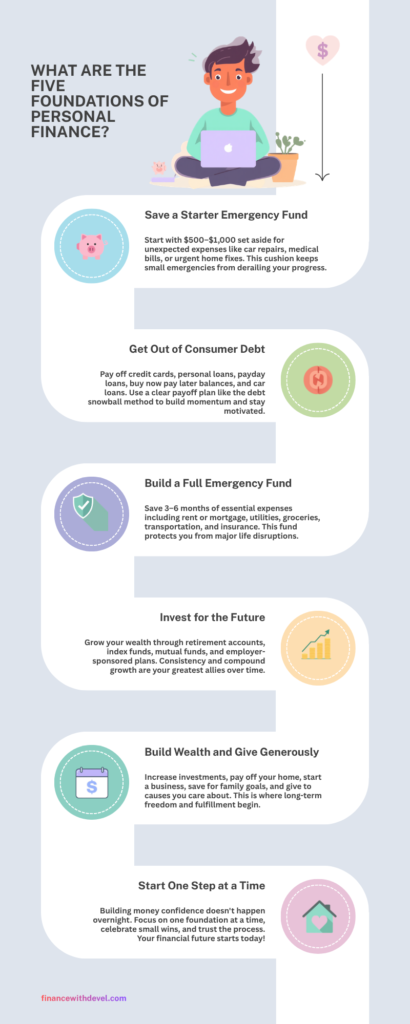
If you are asking, what are the five foundations of personal finance, the simple answer is this: they are five basic money steps that help a person move from financial stress to financial control. The commonly taught Ramsey Education version lists them as: save a $500 emergency fund, get out of debt, pay cash for your car, pay cash for college, and build wealth and give. These steps were originally designed to help students understand money before adulthood, but honestly, they are useful for adults too because most money problems do not start with complicated investments; they start with weak basics.
The reason what are the five foundations of personal finance is such a powerful topic is that people often jump straight to crypto, stocks, side hustles, or “how to become rich fast” before learning how to handle an emergency bill. That is like trying to build a luxury apartment on wet mud. The foundation has to be strong first. According to the Federal Reserve’s 2025 household well-being report, only 63% of adults said they could cover a $400 emergency using cash, savings, or a credit card paid off at the next statement, while 55% had three months of emergency savings.
The Current Money Reality
The money world in 2026 feels expensive, fast, and honestly a little noisy. Rent is high, food is expensive, cars cost more, college is still a major burden, and social media keeps showing people living lifestyles that may be funded by credit cards, not income. FINRA Foundation’s 2025 National Financial Capability Study reported a decline in Americans’ ability to make ends meet and save for emergencies, even though the study did not show an overall income decline; the pressure came largely from higher costs.
That is exactly why people search what are the five foundations of personal finance. They do not always need a complicated wealth strategy first. They need a clean order of action. Personal finance becomes easier when you know what to do first, second, third, fourth, and fifth. Without that order, money decisions become emotional: you invest while carrying credit card debt, buy a car before building savings, or borrow heavily for college without comparing cheaper options. The five foundations create a sequence, and that sequence protects you from making expensive decisions at the wrong time.
Who Should Follow These Foundations?
The answer to what are the five foundations of personal finance is especially helpful for students, beginners, young professionals, new earners, families trying to reset their finances, and anyone who feels like money disappears every month. You do not need to be rich to start. In fact, the system is most useful when money is tight because it gives every rupee, dollar, or euro a job. It is not about looking wealthy; it is about becoming stable first.
Think of these foundations like learning driving before buying a sports car. Budgeting, saving, debt control, smart education planning, and investing are basic skills. If you skip them, income alone may not save you. Many people earn well but still feel broke because their payments, lifestyle, and debt rise with their salary. When you understand what are the five foundations of personal finance, you stop asking only, “How much do I earn?” and start asking, “How much do I keep, protect, grow, and use wisely?”
Foundation #1: Save a $500 Emergency Fund
The first answer to what are the five foundations of personal finance is simple: save a small emergency fund before anything else. Ramsey Education describes the first foundation as saving a $500 emergency fund, mainly for students and beginners. For adults, the number can be adjusted based on country, income, and monthly expenses, but the idea remains the same: build a small cash cushion so one surprise expense does not push you into debt.
An emergency fund is not investment money. It is not vacation money. It is not for buying a new phone because there is a sale. The Consumer Financial Protection Bureau defines an emergency fund as a cash reserve set aside for unplanned expenses or financial emergencies, such as car repairs, home repairs, medical bills, or income loss. The CFPB also warns that without savings, even a small financial shock can set someone back and may lead to debt.
Why a Starter Emergency Fund Works
The beauty of a starter emergency fund is psychological. When you have zero savings, every problem feels like a crisis. A flat tire, a broken appliance, a medical bill, or a delayed salary can create panic. But when you have even a small emergency fund, your brain behaves differently. You are no longer reacting like a person trapped in a burning room; you are making decisions like someone with options.
This is why what are the five foundations of personal finance begins with savings, not investing. Investing is powerful, but it is not useful if you keep withdrawing money every time life happens. A starter emergency fund creates breathing room. It protects you from using credit cards, payday loans, personal loans, or borrowing from friends for every small problem. It also builds your first financial win, and that matters because confidence is fuel. Once you prove to yourself that you can save $500, saving $1,000, then one month of expenses, then three months becomes much more realistic.
How to Build Your First Emergency Fund
To build your first emergency fund, start by opening a separate savings account or keeping the money in a safe, liquid place. The key word is liquid, meaning you can access it quickly when needed. Do not put your starter emergency fund in stocks, crypto, long-term deposits with penalties, or anything risky. Emergency money should be boring. Boring money saves you when exciting money fails.
The fastest way to save your first emergency fund is to temporarily cut non-essential spending and direct every small saving toward one target. Cancel unused subscriptions, reduce food delivery, delay impulse purchases, sell unused items, take small freelance work, or save part of every paycheck before spending. If you are wondering what are the five foundations of personal finance and where to start today, start with this: write your emergency fund target on paper, decide a deadline, and automate a small transfer every week. Even $25 per week becomes $500 in 20 weeks. The number is less important than the habit, because this foundation trains your money discipline.
Foundation #2: Get Out of Debt
The second answer to what are the five foundations of personal finance is getting out of debt. Debt is not just a number on a statement; it is a claim on your future income. Every monthly payment you create today becomes less freedom tomorrow. Credit cards, personal loans, auto loans, student loans, buy-now-pay-later plans, and unpaid balances can quietly turn your salary into a waiting room where everyone else gets paid before you do.
Ramsey Education teaches getting out of debt after saving the starter emergency fund, and it recommends using the debt snowball method: list debts from smallest to largest, pay minimums on all debts, and attack the smallest debt first to build momentum. This method is not always mathematically perfect compared with paying the highest interest rate first, but it works for many beginners because motivation matters. Personal finance is not only math; it is behavior. If math alone solved money problems, nobody with a calculator would be broke.
Why Debt Slows Down Your Future
Debt becomes dangerous because it feels normal. A small EMI here, a credit card balance there, a phone on installments, a car loan, a personal loan for a wedding, and suddenly your monthly income has too many holes. You may earn more every year but still feel stuck because debt absorbs your raises before they can build wealth. That is why what are the five foundations of personal finance puts debt payoff before luxury purchases and big investing dreams.
Current data shows why this matters. Federal Student Aid reported in March 2026 that the outstanding federal student loan portfolio included 42.8 million recipients and totaled $1.7 trillion as of December 31, 2025. It also reported that 23.2% of recipients with loans in active repayment were more than 30 days delinquent. Debt stress is not imaginary. It affects cash flow, mental peace, credit scores, future borrowing ability, and even career choices. When your payments are heavy, you may not take a better long-term opportunity because you need immediate cash just to survive the month.
The Debt Snowball Method
The debt snowball method is simple enough for anyone to start. First, stop taking new debt. Second, list every debt except the mortgage, from smallest balance to largest balance. Third, pay the minimum on all debts and put every extra amount toward the smallest one. Fourth, when the smallest debt is gone, roll that payment into the next one. Like a snowball rolling downhill, the payment grows bigger as each debt disappears.
This method is powerful because small wins create momentum. Imagine you have four debts: $200, $800, $2,000, and $5,000. Paying off the $200 debt first may not save the most interest, but it gives you a quick victory. That victory tells your brain, “This is working.” When people ask what are the five foundations of personal finance, they often expect a fancy answer, but the real answer is beautifully practical: build a small emergency fund, stop borrowing, and begin cleaning up the mess one debt at a time. No drama, no magic, just focused action.
Foundation #3: Pay Cash for Your Car
The third answer to what are the five foundations of personal finance is paying cash for your car. This one may feel hard because car payments have become normal in many countries. People often ask, “How much monthly payment can I afford?” instead of asking, “How much car can I actually afford?” That small shift changes everything. A car should make life easier, not become a metal subscription that eats your future wealth.
Why Car Payments Can Damage Your Budget
Car payments are sneaky because they look affordable when viewed monthly, but expensive when viewed over years. A $537 used car payment may not sound shocking until you multiply it by 60 or 72 months. Then add insurance, fuel, maintenance, repairs, registration, parking, and depreciation. Suddenly, the “affordable” car becomes one of the largest financial decisions in your life.
This is why what are the five foundations of personal finance includes paying cash for your car. The goal is not to shame anyone who already has a car loan. The goal is to help people understand that transportation should not delay wealth building for years. If you buy a cheaper used car with cash, you may lose some style points, but you gain freedom. And freedom has a better long-term return than impressing people at a traffic signal. A car should take you to work, not quietly take ownership of your paycheck.
How to Buy a Car Without Debt
- Be patient before buying
- Do not rush into buying a car just because you want one quickly.
- Decide what you truly need
- Focus on safe and reliable transportation.
- Do not buy a car only to impress others.
- Create a separate car replacement fund
- Keep a separate savings account only for your future car purchase.
- Save monthly like you already have a car payment
- Instead of paying EMI to a lender, pay that amount to yourself every month.
- Buy within your saved amount
- Choose a reliable used car that fits your budget.
- Avoid borrowing money just to buy a more expensive car.
- Keep saving after buying the car
- Continue saving for repairs, maintenance, insurance, and future replacement.
- Avoid lifestyle pressure
- A simple paid-off car is better than an expensive car with stressful monthly payments.
If you already have a car loan, do not panic. You can treat it as part of Foundation #2 and pay it off faster. If the payment is crushing your budget, consider selling the car and buying a cheaper one, especially if the numbers make sense. When people ask what are the five foundations of personal finance, this foundation often creates the most resistance because cars are emotional. But once you experience life without a car payment, it feels like getting a raise without changing jobs.
Foundation #4: Pay Cash for College
The fourth answer to what are the five foundations of personal finance is paying cash for college. This does not mean education is bad. Education can be one of the best investments of your life when the cost, career path, and expected income make sense. The problem starts when students borrow blindly without understanding the repayment burden. A degree should open doors, not chain your ankle to payments for 10, 15, or 20 years.
College Board reported that parents and students borrowed $102.6 billion in federal and nonfederal loans for postsecondary education in 2024–25. It also reported that bachelor’s degree recipients who borrowed for college in 2023–24 borrowed an average of $29,560. Those figures show why this foundation deserves serious attention. Education is important, but the financing method matters.
Why Student Loans Need Careful Planning
Student loans can feel harmless at the beginning because repayment often starts later. That delay creates a dangerous illusion. You may sign loan documents at 18 or 20 without fully feeling the weight of the payments that arrive after graduation. By the time repayment begins, life has also started: rent, food, transport, insurance, family responsibilities, career uncertainty, and maybe relocation costs. The loan that once felt like “future me’s problem” becomes today’s monthly pressure.
That is why what are the five foundations of personal finance teaches students and families to think before borrowing. The right question is not only, “Can I get admission?” The better question is, “Can I afford this education without damaging my financial future?” If the course leads to strong income and the debt is limited, the decision may still make sense for some people. But borrowing large amounts for a low-income path without a clear plan can create years of stress.
Education is one of the biggest investments you will ever make, so it should not be chosen only because a college looks popular or a course sounds impressive. Before spending thousands of dollars or taking a student loan, pause and think like an investor: How much will this degree cost? What skills will I gain? What career opportunities can it create? How much can I realistically earn after graduation? And how long will it take to recover the money I spent? When you plan education this way, a degree becomes more than a certificate — it becomes a smart step toward a stronger financial future.
Practical Ways to Avoid Student Debt
There are many ways to reduce or avoid student debt. Start with scholarships, grants, work-study programs, community college, in-state public universities, employer tuition support, part-time work, online credits, and choosing a school based on value rather than branding alone. A famous university name can help in some fields, but overpaying for a degree with weak career outcomes can hurt. The smartest education plan balances ambition with affordability.
Parents can also begin saving early through education-specific savings plans available in their country. Students can work during holidays, build skills online, apply widely for scholarships, and avoid lifestyle inflation during college. If you are asking what are the five foundations of personal finance as a parent, this foundation is your reminder to plan early. If you are asking as a student, it is your reminder that your future salary is precious. Do not sell too much of it before you even earn it.
Foundation #5: Build Wealth and Give
The fifth answer to what are the five foundations of personal finance is building wealth and giving. This is where the earlier foundations start paying you back. Once you have emergency savings, no consumer debt, no car payment, and a smart education plan, your income becomes powerful. Money that once went to lenders can now go toward investing, business building, home ownership, retirement, and generosity.
This foundation matters because financial peace is not only about avoiding bad things. It is also about creating good things. You invest so your future self has options. You build wealth so your family has stability. You give because money should not turn your heart into a locked room. A strong personal finance plan protects you, grows you, and allows you to help others without destroying your own stability.
Why Investing Early Matters
Investing early works because of compounding. Compounding is like planting a tree that eventually drops seeds and grows more trees. At first, the growth looks slow. Later, it can become surprisingly powerful. The person who starts investing small amounts early often beats the person who waits years and then tries to catch up with larger amounts. Time is the quiet engine of wealth.
When people ask what are the five foundations of personal finance, they often want to jump directly to this step. That is understandable because investing sounds exciting. But investing while drowning in high-interest debt is like filling a bucket that has holes at the bottom. First, patch the holes. Then pour water. Once you are ready, focus on diversified, long-term investing through retirement accounts, index funds, mutual funds, or other regulated options depending on your country. Avoid chasing hype. Real wealth usually grows slowly, boringly, and consistently before it looks impressive.
Why Giving Belongs in Personal Finance
Giving may seem unusual in a personal finance foundation, but it belongs here because money is not only a calculator topic. It is a character topic too. If wealth makes you more fearful, more selfish, and more stressed, then something is missing. Giving reminds you that money is a tool, not your identity. It can support family, education, health, community, faith, charity, or people in need.
The best part is that giving does not have to wait until you are extremely rich. You can start small and grow gradually. Even a modest giving habit teaches gratitude and discipline. When you understand what are the five foundations of personal finance, you realize the final goal is not just “more money.” The goal is more freedom, more peace, more choices, and more impact. Wealth without purpose can feel empty. Wealth with generosity becomes meaningful.
Five Foundations Comparison Table
| Foundation | Main Goal | Why It Matters | Beginner Action |
|---|---|---|---|
| Save a $500 emergency fund | Build basic safety | Prevents small emergencies from becoming debt | Save weekly in a separate account |
| Get out of debt | Free your income | Reduces stress and monthly obligations | Use the debt snowball method |
| Pay cash for your car | Avoid long-term payments | Protects your monthly budget | Save before upgrading |
| Pay cash for college | Reduce student loan burden | Keeps education from becoming a financial trap | Apply for scholarships and choose value |
| Build wealth and give | Grow long-term freedom | Turns income into assets and impact | Invest consistently and give intentionally |
This table gives the cleanest answer to what are the five foundations of personal finance. Each step has a purpose, and the order matters. Saving protects you from emergencies. Debt payoff frees your income. Paying cash for cars and college prevents major future burdens. Building wealth and giving turns financial discipline into long-term freedom. If you follow the order, your money life becomes less chaotic and more intentional.
Common Mistakes to Avoid
The first common mistake is trying to do everything at once. People want to save, invest, repay debt, upgrade their car, travel, and start a business all in the same month. That sounds ambitious, but it often creates confusion. The power of what are the five foundations of personal finance is focus. You do not need ten priorities. You need the right priority at the right time.
The second mistake is treating credit as income. A credit card limit is not money. A loan approval is not affordability. Buy-now-pay-later is not a discount. These tools can make life look easier today while making tomorrow heavier. The third mistake is ignoring lifestyle inflation. When income rises, many people immediately upgrade their phone, car, apartment, restaurants, and vacations. Their income grows, but their freedom does not. The fourth mistake is waiting too long to invest after becoming debt-free. Once your foundation is strong, you need to put money to work. Cash protects short-term stability, but long-term wealth usually needs productive assets.
Conclusion
So, what are the five foundations of personal finance? They are: save a $500 emergency fund, get out of debt, pay cash for your car, pay cash for college, and build wealth and give. These five steps are simple, but simple does not mean weak. Most financial success comes from doing basic things consistently for a long time. The person who saves regularly, avoids unnecessary debt, buys within their means, plans education carefully, invests patiently, and gives generously is already ahead of many people chasing shortcuts.
The best way to start is not to wait for perfect income. Start with the first foundation. Save your first small emergency fund. Then attack debt. Then avoid big payment traps. Then plan education wisely. Then build wealth slowly and intentionally. If you remember one thing from this guide, remember this: personal finance is not about looking rich today; it is about becoming free tomorrow.
FAQs
1. What are the five foundations of personal finance in simple words?
The five foundations of personal finance are five beginner-friendly money steps: save a $500 emergency fund, get out of debt, pay cash for your car, pay cash for college, and build wealth and give. They are designed to help people create financial stability before taking bigger financial risks. The steps work best when followed in order because each foundation supports the next one. Think of them like a staircase: you climb faster when you do not skip steps.
2. Is a $500 emergency fund enough?
A $500 emergency fund is a starter amount, not the final goal. It is mainly useful for beginners, students, or people who are still paying off debt. Once high-interest debt is gone, most people should aim for a larger emergency fund of three to six months of essential expenses. The first $500 simply helps you stop relying on debt for small emergencies.
3. Should I invest while paying off debt?
It depends on the type of debt, interest rate, employer benefits, and your financial situation. Many people focus first on paying high-interest debt because the guaranteed “return” from removing expensive interest can be powerful. Some may still contribute enough to get an employer retirement match if available. The main idea is to avoid investing aggressively while expensive debt is quietly eating your cash flow.
4. Why is paying cash for a car part of personal finance?
Paying cash for a car helps you avoid years of monthly payments. Car loans can make people buy more car than they truly need because the cost is hidden inside a monthly EMI. When you save first and buy with cash, you usually choose more carefully. That keeps your budget lighter and leaves more money for savings, investing, and important goals.
5. How can students follow the five foundations of personal finance?
Students can start by saving a small emergency fund from part-time work, gifts, scholarships, or small business income. They can avoid credit card debt, choose affordable transportation, apply for scholarships, compare college costs, and learn basic investing early. The goal is not to become perfect overnight. The goal is to graduate into adulthood with fewer financial chains and better money habits.
Your Turn: Which Foundation Will You Start With?
Now that you understand the five foundations of personal finance, the next step is simple: choose one foundation and start today. You do not need to fix your entire financial life in one day. Start small, stay consistent, and build confidence step by step.
Tell us in the comments:
- Which foundation are you currently working on?
- Do you already have an emergency fund?
- Are you trying to pay off debt?
- What is your biggest personal finance challenge right now?
- Which money habit do you want to improve this year?
Your answer may also help other readers who are facing the same situation. Personal finance becomes easier when people share real experiences, practical tips, and honest mistakes.
Challenge for you:
Pick one foundation from this article and take one small action today. Save your first $10, list your debts, avoid one unnecessary purchase, research cheaper college options, or start learning about investing.
Share this article with someone who wants to improve their money habits but does not know where to start.
Related Articles You May Also Like
- How to Create a Monthly Budget in 2026
- 50/30/20 Budget Rule Explained
- How to Build an Emergency Fund Fast
- Debt Snowball Method Explained
- Best Ways to Save Money as a Beginner

“Hi, I am Devel Gupta, an entrepreneur and the founder of FinanceWithDevel. With 10 years of experience in teaching and simplifying personal finance, my mission is to help beginners build long-term wealth without the confusing jargon. Whether it’s budgeting, investing, or retirement planning, I believe financial freedom starts with simple, consistent habits. Let’s make money make sense. Connect with me on [ LinkedIn/Twitter ] for more daily tips!”