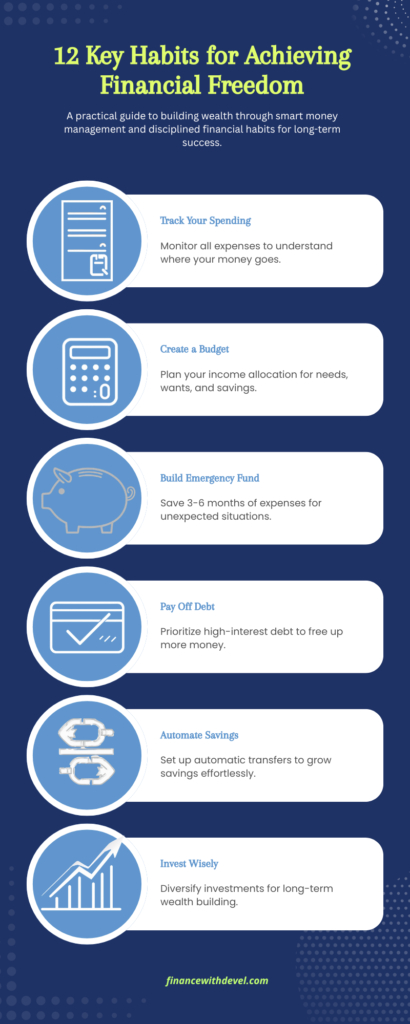
What Financial Freedom Really Means
12 Key Habits for Achieving Financial Freedom is not just about becoming rich, buying luxury cars, or retiring on a beach with a laptop and coconut water. Real financial freedom means having enough control over your money that your life decisions are not controlled by bills, debt, fear, or paycheck pressure. It means you can pay your expenses, handle emergencies, invest for the future, and still sleep peacefully at night. For some people, financial freedom means retiring early; for others, it simply means not panicking when rent, groceries, insurance, or medical bills arrive in the same month.
Financial freedom is also deeply personal. A single person living in Texas may need a very different amount than a family of four living in California or New York. That is why 12 Key Habits for Achieving Financial Freedom focuses more on behavior than on one magic number. Your habits decide whether your income turns into wealth or disappears like water leaking from a bucket. You can earn $40,000 and build stability, or earn $150,000 and still feel broke if your habits are weak. Money is not only mathematics; it is discipline, awareness, patience, and smart decision-making repeated again and again.
Why Financial Freedom Is More Important in 2026
12 Key Habits for Achieving Financial Freedom matters even more now because Americans are dealing with high living costs, debt pressure, and uncertainty around jobs, inflation, housing, and retirement. According to the Federal Reserve’s 2025 Survey of Household Economics and Decisionmaking, 73% of adults said they were “doing okay financially” or “living comfortably,” but price increases remained the most common financial concern, with just above 9 in 10 adults saying price increases were a minor or major concern. The same report found that 63% of adults could cover a $400 emergency using cash, savings, or a credit card paid off at the next statement.
That number sounds decent at first, but it also means many households are still financially fragile. The Federal Reserve report also found that 59% of adults had at least one major unexpected expense in the prior 12 months, including vehicle repairs, home or appliance repairs, and medical expenses. This is exactly why 12 Key Habits for Achieving Financial Freedom is not theory; it is survival plus growth. If one car repair, one medical bill, or one job gap can shake your whole financial life, then building better habits becomes urgent, not optional.
Habit 1: Know Exactly Where Your Money Goes
The first habit in 12 Key Habits for Achieving Financial Freedom is simple but powerful: track your money. Most people do not fail financially because they are careless with one huge purchase. They fail because hundreds of small unplanned expenses quietly eat their income. A streaming subscription here, food delivery there, impulse Amazon orders, extra coffee runs, unused memberships, convenience fees, and “small treats” can easily become hundreds of dollars every month. Tracking money is like turning on the lights in a dark room; suddenly, you can see where things are messy.
You do not need a complicated spreadsheet to begin. A budgeting app, bank statement, notebook, or simple Google Sheet can work. The key is to divide your spending into categories such as housing, groceries, transportation, insurance, debt payments, subscriptions, entertainment, and savings. Once you know where your money is going, you can make better decisions without guessing. The Bureau of Labor Statistics reported that average annual expenditures for all U.S. consumer units were $78,535 in 2024, while average income before taxes was $104,207. That gap between income and spending is where financial freedom begins—if you manage it wisely.
Habit 2: Spend Less Than You Earn
The second habit in 12 Key Habits for Achieving Financial Freedom is the foundation of every wealth-building plan: spend less than you earn. It sounds almost too basic, but this is the rule that separates people who build wealth from people who only look successful. If you earn $8,000 per month and spend $8,200, your lifestyle is not affordable. If you earn $4,000 and spend $3,200, you have room to save, invest, and breathe. The difference is not only income; it is margin.
Spending less than you earn does not mean living a boring life or never enjoying your money. It means giving every dollar a job before it disappears. You can still eat out, travel, buy nice clothes, and enjoy life, but those choices should fit inside your financial plan. Think of your income like a water tank. If every pipe is open, nothing remains. But if you control the flow, you can store water for dry days and future growth. This habit creates the cash flow needed for emergency savings, debt payoff, investing, and long-term independence.
Habit 3: Build an Emergency Fund
A strong emergency fund is one of the most important parts of 12 Key Habits for Achieving Financial Freedom because life does not ask for permission before becoming expensive. Cars break down. Jobs disappear. Medical bills arrive. Rent increases. Appliances stop working at the worst possible time. Without emergency savings, many people are forced to use credit cards, payday loans, personal loans, or borrowed money from family, which can turn one problem into a long-term financial trap.
The Consumer Financial Protection Bureau recommends creating a savings habit by setting a goal and building a system to save regularly. This is practical advice because motivation alone is unreliable. Some months you will feel excited to save; other months you will not. A system keeps working even when motivation is low. Start with a small goal like $500 or $1,000, then build toward one month of expenses, then three to six months depending on your job stability, family needs, debt level, and health situation.
How Much Emergency Cash Should You Keep?
The right emergency fund depends on your life. If you have stable employment, low debt, and no dependents, three months of essential expenses may be a good starting point. If you are self-employed, work on commission, support family members, or live in a high-cost city, six months or more may be safer. 12 Key Habits for Achieving Financial Freedom is not about copying someone else’s number; it is about building a safety net that protects your own life.
Keep emergency money separate from your daily spending account. A high-yield savings account can be useful because your money remains accessible while still earning some interest. The goal is not to chase huge returns with emergency cash. The goal is safety, liquidity, and peace of mind. Your emergency fund is like a financial seat belt. You hope you do not need it, but when life crashes into you, you will be glad it is there.
Habit 4: Pay Off High-Interest Debt
High-interest debt is one of the biggest enemies of financial freedom. That is why debt payoff is central to 12 Key Habits for Achieving Financial Freedom. Credit card balances, payday loans, high-rate personal loans, and expensive buy-now-pay-later habits can quietly drain your future. When interest rates are high, your money works against you instead of for you. You may feel like you are making payments every month, but the balance barely moves because interest keeps eating your progress.
The New York Fed reported that total U.S. household debt reached $18.8 trillion in the first quarter of 2026. That number shows how normal debt has become, but normal does not mean healthy. Two common payoff methods are the debt snowball and debt avalanche. The snowball method focuses on paying the smallest balance first for motivation. The avalanche method focuses on the highest interest rate first to save the most money mathematically. Both can work. The best method is the one you can follow consistently without quitting halfway.
Habit 5: Invest Early and Consistently
Investing is where 12 Key Habits for Achieving Financial Freedom shifts from defense to offense. Saving protects you, but investing helps your money grow. Many beginners wait too long because they think they need perfect knowledge, perfect timing, or a large amount of money. In reality, time in the market is often more powerful than trying to perfectly time the market. A person who starts investing small amounts early may build more wealth than someone who waits for the “perfect moment” and starts much later.
Consistency matters more than drama. You do not need to chase hot stocks, viral crypto tips, or complicated strategies to start building wealth. Many long-term investors use diversified index funds, retirement accounts, and automatic contributions. The SEC’s Investor.gov explains compound interest as “interest you earn on interest,” using the example that $100 earning 5% becomes $105 after one year and $110.25 after the second year because the interest also starts earning interest. That simple idea is one of the strongest engines behind long-term wealth.
Why Compound Growth Matters
Compound growth is like planting a tree. In the early years, progress may look slow, and you may wonder whether anything is happening. But under the surface, roots are growing. Over time, the growth becomes more visible, and eventually the tree starts giving shade. 12 Key Habits for Achieving Financial Freedom works the same way. Your first $1,000 invested may not feel life-changing, but it builds the habit. Your first $10,000 builds confidence. Your first $100,000 can become the base that accelerates everything.
The danger is stopping too early. Many people invest for a few months, get scared by market volatility, and quit. But investing is not supposed to feel exciting every day. It is supposed to be boring, steady, and long-term. The goal is not to predict every market move. The goal is to own productive assets over time, keep costs low, stay diversified, and avoid emotional decisions.
Habit 6: Increase Your Income
Cutting expenses is important, but income growth is also a major part of 12 Key Habits for Achieving Financial Freedom. There is a limit to how much you can cut, but there may be much more room to earn. You can increase income through career growth, freelancing, side businesses, digital products, consulting, overtime, certifications, sales skills, or moving into higher-paying industries. For many people, one strong income upgrade can do more than years of tiny cost-cutting.
The key is to avoid using every income increase for lifestyle upgrades. If your salary rises by $1,000 per month and your spending rises by $1,000 per month, your financial freedom has not improved. Use raises, bonuses, tax refunds, and side income as wealth-building fuel. Put a portion toward debt, a portion toward investments, and a portion toward your emergency fund. Income is like the size of the engine; habits decide whether that engine moves you forward or just burns fuel.
Habit 7: Avoid Lifestyle Inflation
Lifestyle inflation happens when your spending rises every time your income rises. This habit can quietly destroy wealth, which is why avoiding it belongs in 12 Key Habits for Achieving Financial Freedom. You get a raise, then upgrade your car. You earn more, then move to a more expensive apartment. Your business improves, then your shopping increases. At first, it feels like progress. But if your savings rate does not improve, you are just running on a more expensive treadmill.
This does not mean you should never improve your lifestyle. You work hard, so it is fair to enjoy some rewards. The trick is to upgrade slowly and intentionally. A good rule is to save or invest a meaningful percentage of every raise before increasing spending. For example, if your income increases by $500 per month, you might invest $250, save $150, and use $100 for lifestyle improvements. That way, your life improves today while your future also becomes stronger.
Habit 8: Set Clear Financial Goals
Goals turn vague dreams into measurable targets. That is why goal-setting is a major part of 12 Key Habits for Achieving Financial Freedom. Saying “I want to be rich” is too unclear. Saying “I want to save $20,000 for an emergency fund in 24 months” is specific. Saying “I want to retire early” is vague. Saying “I want to build a $1 million investment portfolio by age 55” gives your money a direction.
Good financial goals usually include a number, a deadline, and a reason. The reason matters because money goals can feel boring when life gets busy. If your goal is to become debt-free so you can start a business, travel with your family, reduce stress, or retire your spouse early, that emotional connection keeps you motivated. Your goals should include short-term, medium-term, and long-term targets. Short-term goals create momentum. Medium-term goals build structure. Long-term goals give your financial life purpose.
Habit 9: Use Retirement Accounts Wisely
Retirement accounts are powerful tools in 12 Key Habits for Achieving Financial Freedom because they offer tax advantages and long-term investing structure. In the U.S., common retirement accounts include 401(k)s, traditional IRAs, Roth IRAs, SEP IRAs, SIMPLE IRAs, and Solo 401(k)s for eligible self-employed people. These accounts can help you invest consistently while reducing taxes now or creating tax-free income later, depending on the account type.
For 2026, the IRS announced that the 401(k) employee contribution limit increased to $24,500, while the IRA contribution limit increased to $7,500. The IRS also said the 401(k) catch-up contribution limit for most workers age 50 and older increased to $8,000, allowing eligible participants to contribute up to $32,500 in 2026. These limits matter because tax-advantaged space is valuable. If your employer offers a 401(k) match, try not to leave free money on the table. That match is part of your compensation, not a bonus gift from the sky.
Habit 10: Protect Yourself With Insurance
One unexpected event can wipe out years of progress, so protection is a necessary part of 12 Key Habits for Achieving Financial Freedom. Health insurance, auto insurance, homeowners or renters insurance, disability insurance, life insurance, and liability coverage may not feel exciting, but they protect your financial foundation. Building wealth without protection is like building a beautiful house without locking the doors. Everything may look fine until one major event exposes the weakness.
The right insurance depends on your life stage. A single renter may need health, auto, renters, and disability coverage. A parent with dependents may also need term life insurance. A homeowner may need strong property coverage and umbrella liability protection. The goal is not to buy every policy available. The goal is to protect against risks that could financially destroy you. Insurance is not an investment in the usual sense; it is a shield.
Habit 11: Keep Learning About Money
Financial education is a lifelong habit. That is why 12 Key Habits for Achieving Financial Freedom includes continuous learning. Money rules change, tax limits change, interest rates change, investment products change, and scams become more advanced. If you stop learning, your financial decisions can become outdated. You do not need to become a Wall Street expert, but you should understand budgeting, credit scores, debt, taxes, investing, insurance, retirement accounts, and basic estate planning.
FINRA says saving and investing can help people achieve financial goals such as paying for college or enjoying a secure retirement. That sounds simple, but many people never learn the basics until they make expensive mistakes. Read trusted financial education sites, use calculators, follow credible experts, and question anything that promises quick wealth with no risk. The more you learn, the harder it becomes for bad advice, scams, and emotional decisions to control your money.
Habit 12: Review Your Financial Plan Regularly
The final habit in 12 Key Habits for Achieving Financial Freedom is regular review. A financial plan is not something you create once and forget forever. Life changes. Income changes. Family needs change. Tax rules change. Markets change. Your goals at age 25 may look very different at age 35, 45, or 60. Reviewing your plan helps you adjust before small problems become big ones.
A simple monthly money review can include checking spending, savings, debt balances, investment contributions, credit card activity, and upcoming bills. A deeper yearly review can include insurance coverage, retirement progress, tax planning, estate documents, and long-term goals. Think of it like a car service. You do not wait for the engine to fail before checking the oil. Regular maintenance keeps your financial life running smoothly.
Financial Freedom Habit Comparison Table
| Habit | Why It Matters | Simple Action Step |
|---|---|---|
| Track spending | Shows where money is leaking | Review bank statements weekly |
| Spend less than you earn | Creates financial margin | Set a monthly savings target |
| Build emergency savings | Protects against surprise expenses | Save first $1,000, then grow |
| Pay off debt | Reduces interest pressure | Use snowball or avalanche method |
| Invest consistently | Builds long-term wealth | Automate monthly contributions |
| Increase income | Speeds up financial progress | Build one high-income skill |
| Avoid lifestyle inflation | Keeps raises from disappearing | Invest part of every raise |
| Set goals | Gives money direction | Write goals with amount and deadline |
| Use retirement accounts | Adds tax advantages | Contribute to 401(k) or IRA |
| Buy insurance | Protects wealth | Review coverage yearly |
| Keep learning | Improves decisions | Read one finance topic weekly |
| Review plan | Keeps progress on track | Do monthly and yearly reviews |
Common Mistakes to Avoid
Even if you understand 12 Key Habits for Achieving Financial Freedom, you can still slow your progress by making common mistakes.
The first mistake is waiting too long to start. Many people think they will begin saving and investing when they earn more, but when income rises, expenses often rise too. Start with what you have. A small habit today is better than a perfect plan next year.
The second mistake is focusing only on income while ignoring spending. A high income can hide bad habits for a while, but it cannot fix uncontrolled spending forever.
The third mistake is investing without an emergency fund. If you invest every dollar and then face an emergency, you may be forced to sell investments at the wrong time or take on debt.
The fourth mistake is copying other people’s lifestyles. Your neighbor’s car, vacation, or house does not show their debt, stress, or financial reality. Build a plan for your life, not for someone else’s Instagram.
Conclusion
12 Key Habits for Achieving Financial Freedom is really about building a life where money becomes a tool instead of a constant source of stress. You do not need to master everything in one week. Start by tracking your money, spending less than you earn, building a small emergency fund, and paying down high-interest debt. Then move toward consistent investing, income growth, retirement planning, insurance protection, and regular reviews.
Financial freedom is not built by one lucky investment or one perfect decision. It is built by repeated habits that look small in the beginning but become powerful over time. Every dollar you save, every debt payment you make, every investment contribution you automate, and every bad spending habit you break moves you closer. The goal is not to become perfect with money. The goal is to become consistent enough that your future self thanks you.
FAQs
1. What is the meaning of financial freedom?
Financial freedom means having enough income, savings, investments, and control over expenses that you are not completely dependent on your next paycheck. It does not always mean being extremely rich. For many people, it means having no high-interest debt, a strong emergency fund, steady investments, and the ability to make life choices without constant money stress.
2. How much money do I need for financial freedom?
The amount depends on your lifestyle, location, family size, debt, health needs, and retirement goals. Someone with low expenses may need much less than someone living in a high-cost city with dependents. A good starting point is to calculate your annual expenses and estimate how much investment income would be needed to cover them.
3. What is the first habit I should start with?
Start by tracking your money. You cannot fix what you cannot see. Once you know where your income is going, it becomes easier to cut waste, save more, pay off debt, and invest consistently. Tracking creates awareness, and awareness creates better decisions.
4. Can I achieve financial freedom with a normal salary?
Yes, financial freedom is possible with a normal salary, but it requires patience, discipline, and smart planning. The key is to maintain a savings gap between income and expenses, avoid high-interest debt, invest consistently, and increase income over time. A high salary helps, but strong habits matter more.
5. How long does financial freedom take?
It depends on your starting point, savings rate, income, debt level, investment returns, and lifestyle goals. Some people may create basic financial stability in one to three years, while full financial independence may take 10, 20, or 30 years. The earlier you start building these habits, the more time your money has to grow.
Want to build a stronger money foundation before working toward financial freedom? Read our detailed guide: [How Much Emergency Fund Should Americans Save in 2026?]
Disclaimer
This article is for educational and informational purposes only and should not be considered financial, investment, tax, or legal advice. Personal finance decisions depend on your income, expenses, debt, risk tolerance, family situation, and long-term goals. Before making any major financial decision, such as investing, choosing retirement accounts, paying off debt, or changing your savings strategy, consider speaking with a qualified financial advisor, tax professional, or legal expert. The information shared here is based on general financial concepts and may not be suitable for everyone. Always do your own research before taking action.

“Hi, I am Devel Gupta, an entrepreneur and the founder of FinanceWithDevel. With 10 years of experience in teaching and simplifying personal finance, my mission is to help beginners build long-term wealth without the confusing jargon. Whether it’s budgeting, investing, or retirement planning, I believe financial freedom starts with simple, consistent habits. Let’s make money make sense. Connect with me on [ LinkedIn/Twitter ] for more daily tips!”