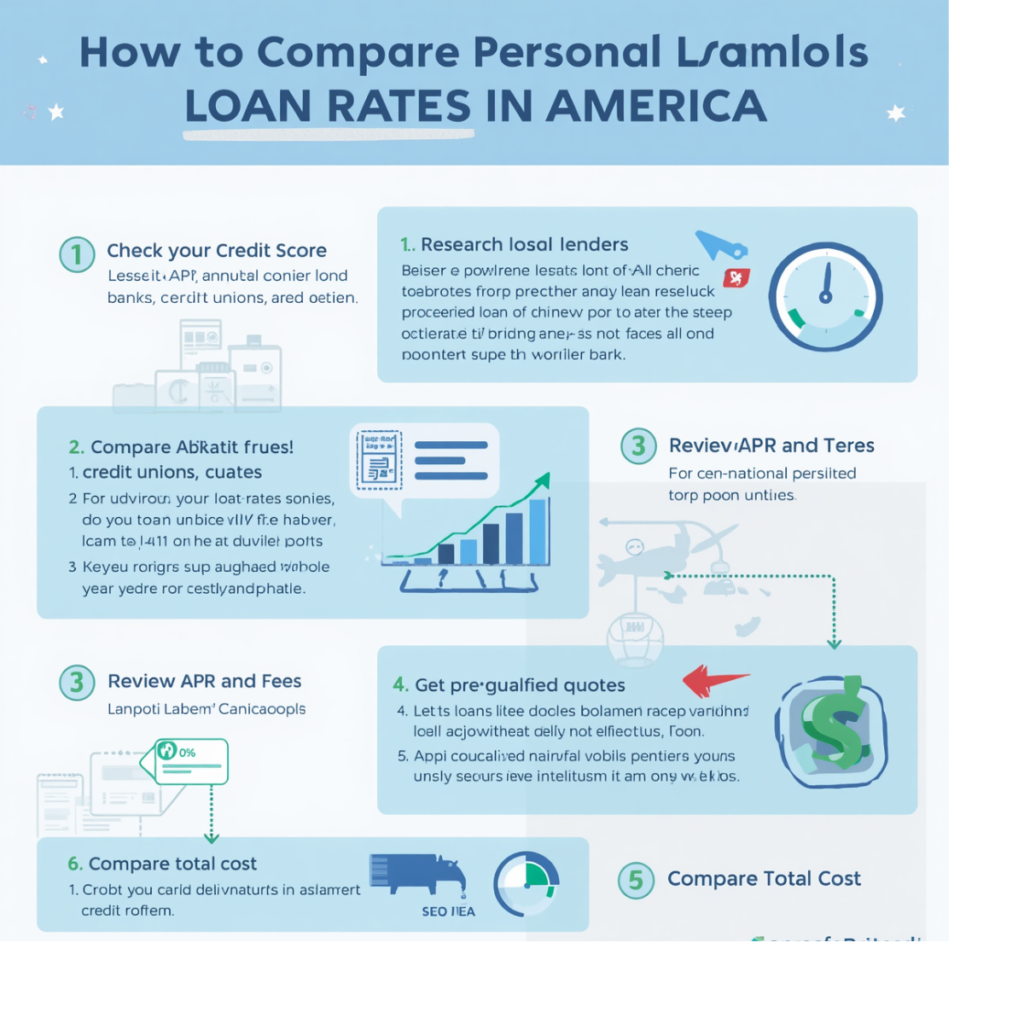
Personal loans can look simple from the outside: borrow money, repay in monthly installments, and move on. But the real cost of a personal loan depends on more than just the interest rate shown in big bold numbers. To make a smart borrowing decision, you need to know How to Compare Personal Loan Rates in America using APR, fees, loan terms, monthly payments, lender reputation, and your credit profile.
As of late May 2026, the average personal loan interest rate reported by Bankrate was around 12.27%, while borrowers with excellent credit could find lower advertised rates. Federal Reserve/FRED data also showed the finance rate on 24-month personal loans at commercial banks was 11.40% in February 2026. Rates change over time, so always compare live offers before applying.
What Is a Personal Loan Rate?
A personal loan rate is the cost a lender charges you for borrowing money. Most personal loans in America are unsecured, meaning you do not have to put up collateral like a car or house. Because the lender takes more risk, your credit score, income, debt-to-income ratio, and repayment history matter a lot.
When learning How to Compare Personal Loan Rates in America, remember this: the lowest advertised rate is not always the rate you will receive. Many lenders show a rate range, such as 7% to 36%. A borrower with excellent credit may qualify near the lower end, while a borrower with fair credit may receive a much higher offer.
Interest Rate vs APR: Know the Difference
One of the biggest mistakes borrowers make is comparing only the interest rate. The better number to compare is the APR, or annual percentage rate.
The CFPB explains that an interest rate is the cost of borrowing money, while APR includes the interest rate plus certain fees charged by the lender.
That means APR gives you a more complete view of the loan’s true yearly cost.
So, when you research How to Compare Personal Loan Rates in America, “focus on APR first“. A loan with an 11% interest rate and a 5% origination fee may cost more than a loan with a 12% interest rate and no origination fee.
Why Personal Loan Rates Are Different for Every Borrower
Two people can apply for the same loan amount on the same day and receive completely different offers. That happens because lenders price loans based on risk.
Common factors include:
| Factor | Why It Matters |
|---|---|
| Credit score | Higher scores usually qualify for lower rates |
| Income | Stable income improves approval chances |
| Debt-to-income ratio | Lower debt can help you get better offers |
| Loan amount | Larger loans may carry different pricing |
| Loan term | Longer terms can cost more in total interest |
| Lender type | Banks, credit unions, and online lenders price differently |
This is why How to Compare Personal Loan Rates in America is not just about finding one lender. It is about comparing multiple offers based on your own profile.
Step 1: Check Your Credit Score First
Before applying, check your credit score. Your credit score can strongly influence your loan rate. Borrowers with excellent credit generally have more lender options, better approval odds, and lower APRs.
If your credit score is low, you may still qualify for a personal loan, but the rate may be expensive. In that case, you should compare whether a personal loan is truly better than other options like a credit union loan, balance transfer card, secured loan, or waiting a few months to improve your credit.
A smart first step in How to Compare Personal Loan Rates in America is knowing where you stand before lenders evaluate you.
Step 2: Prequalify With Multiple Lenders
Prequalification lets you check estimated rates without a hard credit inquiry in many cases. Not every lender offers it, but many online lenders do.
Try to prequalify with at least three to five lenders. This gives you a realistic rate range instead of relying on advertisements. A lender may advertise “rates starting at 6.99%,” but your actual offer could be 15%, 22%, or higher depending on your credit and income.
When people ask How to Compare Personal Loan Rates in America, the practical answer is simple: compare real offers, not marketing headlines.
Step 3: Compare APR, Not Just Monthly Payment
A low monthly payment may look attractive, but it can hide a higher total cost. For example, a five-year loan may have a lower monthly payment than a three-year loan, but you may pay much more interest over time.
Here is a simple example:
| Loan Amount | APR | Term | Approx. Monthly Payment | Approx. Total Interest |
|---|---|---|---|---|
| $10,000 | 10% | 3 years | $323 | $1,616 |
| $10,000 | 10% | 5 years | $212 | $2,748 |
| $10,000 | 18% | 5 years | $254 | $5,236 |
The longer term feels easier monthly, but it can become more expensive overall. That is why How to Compare Personal Loan Rates in America should always include both monthly payment and total interest.
Step 4: Watch for Origination Fees
Many lenders charge an origination fee. This fee may be deducted from your loan amount or added into the cost of the loan.
For example, if you borrow $10,000 with a 5% origination fee, the lender may deduct $500 and send you only $9,500. But you may still repay the full $10,000 plus interest.
The CFPB notes that personal installment loans can include fees and charges, so borrowers should review lender disclosures carefully before accepting a loan.
This is a major part of How to Compare Personal Loan Rates in America because two loans with the same interest rate can have very different costs after fees.
Step 5: Compare Loan Terms Carefully
Personal loan terms often range from one to seven years, though some lenders offer shorter or longer options. Bankrate notes that many personal loans range from $1,000 to $50,000, while some lenders may offer up to $100,000 depending on qualifications.
A shorter term usually means:
Higher monthly payment
Lower total interest
Faster debt payoff
A longer term usually means:
Lower monthly payment
Higher total interest
More time in debt
When learning How to Compare Personal Loan Rates in America, choose a term that fits your budget without stretching the loan longer than necessary.
Step 6: Check the Total Cost of the Loan
Before choosing a lender, calculate the total repayment amount. This includes:
- Principal
- Interest
- Origination fee
- Late fees
- Prepayment penalties, if any
- Other lender charges
Some lenders may offer no origination fee, no prepayment penalty, and fixed monthly payments. Others may charge fees that make the loan more expensive even if the advertised rate looks lower.
The best way to understand How to Compare Personal Loan Rates in America is to ask one question: “How much will I pay from start to finish?”
Step 7: Compare Banks, Credit Unions, and Online Lenders
Different lender types serve different borrowers.
Banks
Traditional banks may be good for borrowers who already have a banking relationship. Some banks offer relationship discounts or autopay discounts. However, approval requirements may be stricter.
Credit Unions
Credit unions can be strong options for affordable personal loans. Bankrate reported that credit unions may offer lower average borrowing costs, and federal credit unions generally have an 18% interest rate cap.
Online Lenders
Online lenders are convenient and fast. Many offer prequalification, quick approval, and direct deposit funding. However, rates and fees can vary widely. Some online lenders offer competitive rates for strong borrowers, while others charge very high APRs for riskier borrowers.
A complete guide on How to Compare Personal Loan Rates in America should include all three lender categories.
Step 8: Look Beyond the Rate
A low APR is important, but it is not the only thing that matters. You should also compare:
- Customer service
- Funding speed
- Repayment flexibility
- Autopay discount
- Mobile app experience
- Ability to change payment date
- Late fee policy
- Direct payment to creditors
- Hardship options
For example, if you are using a personal loan to consolidate credit card debt, a lender that pays your credit card companies directly may be useful. If you need money quickly, funding speed matters. If your income varies, flexible payment dates may help.
That is why How to Compare Personal Loan Rates in America is really about comparing the full borrowing experience, not only the APR.
Step 9: Avoid Red Flags
Be careful if a lender:
- Guarantees approval without checking credit
- Asks for upfront payment before giving a loan
- Has unclear fees
- Pressures you to decide immediately
- Does not show APR clearly
- Has poor customer reviews
- Charges extremely high rates
A trustworthy lender should clearly show loan amount, APR, fees, repayment term, monthly payment, and total cost before you sign.
When you understand How to Compare Personal Loan Rates in America, you become harder to trap with bad loan offers.
Example: Comparing Two Personal Loan Offers
Imagine you need a $15,000 personal loan for debt consolidation.
| Loan Offer | APR | Term | Origination Fee | Monthly Payment | Total Cost |
|---|---|---|---|---|---|
| Lender A | 11.5% | 3 years | 5% | Higher | Lower overall |
| Lender B | 13.2% | 5 years | 0% | Lower | Higher overall |
Lender B may feel better because the monthly payment is lower. But if the repayment period is longer, the total interest may be higher. Lender A charges a fee, but the shorter term may still save money.
This example shows why How to Compare Personal Loan Rates in America requires looking at APR, fees, term, and total repayment together.
Best Personal Loan Uses
Personal loans may be useful for:
- Debt consolidation
- Home improvement
- Medical bills
- Emergency expenses
- Major purchases
- Moving costs
- Wedding expenses
But personal loans are not always the best choice. Avoid using personal loans for unnecessary lifestyle spending, risky investments, or expenses you cannot realistically repay.
A good rule: use a personal loan only when it improves your financial situation or solves a necessary problem.
Personal Loan vs Credit Card
A personal loan may be better than a credit card when you need a fixed repayment plan and a lower APR than your credit card. Credit cards often have higher interest rates, especially if you carry a balance month to month.
A personal loan gives you:
- Fixed monthly payment
- Fixed payoff date
- Predictable interest cost
- Structured repayment
A credit card gives you:
- Flexible borrowing
- Revolving credit
- Potential rewards
- But easier overspending risk
If your goal is debt consolidation, How to Compare Personal Loan Rates in America should also include comparing the loan APR against your current credit card APR.
How to Improve Your Personal Loan Rate
You may qualify for a better rate by:
- Improving your credit score
- Paying down credit card balances
- Reducing debt-to-income ratio
- Adding a qualified co-borrower
- Choosing a shorter loan term
- Applying with a credit union
- Setting up autopay
- Comparing more lenders
Small rate differences matter. A 2% lower APR can save hundreds or even thousands of dollars depending on the loan size and term.
So before applying, spend time on How to Compare Personal Loan Rates in America properly. One hour of comparison can save you years of extra interest.
Common Mistakes to Avoid
Mistake 1: Choosing the lowest monthly payment only
A lower monthly payment can mean a longer loan and more total interest.
Mistake 2: Ignoring origination fees
Fees can make a “cheap” loan expensive.
Mistake 3: Applying everywhere at once
Too many hard inquiries can affect your credit. Use prequalification where available.
Mistake 4: Not reading the fine print
Check late fees, payment rules, and prepayment penalties.
Mistake 5: Borrowing more than needed
A bigger loan means more interest and more repayment pressure.
Avoiding these mistakes is a key part of How to Compare Personal Loan Rates in America.
Quick Checklist Before You Accept a Personal Loan
Before signing, ask:
What is the APR?
Is the rate fixed or variable?
Is there an origination fee?
How much money will I actually receive?
What is my monthly payment?
What is the total repayment amount?
Are there late fees?
Is there a prepayment penalty?
Can I afford the payment comfortably?
Did I compare at least three lenders?
This checklist makes How to Compare Personal Loan Rates in America simple and practical.
Final Thoughts
The best personal loan is not always the one with the lowest advertised rate. The best loan is the one with the lowest real cost, affordable monthly payments, fair terms, transparent fees, and a lender you can trust.
To master How to Compare Personal Loan Rates in America, compare APR instead of only interest rate, check origination fees, review repayment terms, calculate total cost, and prequalify with multiple lenders before applying.
A personal loan can be a useful financial tool when used wisely. But if you rush into the first offer, you may pay more than necessary. Take your time, compare carefully, and choose the loan that supports your financial goals instead of creating new stress.
Educational Note: This article is for educational purposes only and should not be considered financial advice. Always review loan terms carefully and consider speaking with a qualified financial professional before borrowing.
Want more personal finance guides? Visit FinanceWithDevel.com for easy-to-understand money tips.

“Hi, I am Devel Gupta, an entrepreneur and the founder of FinanceWithDevel. With 10 years of experience in teaching and simplifying personal finance, my mission is to help beginners build long-term wealth without the confusing jargon. Whether it’s budgeting, investing, or retirement planning, I believe financial freedom starts with simple, consistent habits. Let’s make money make sense. Connect with me on [ LinkedIn/Twitter ] for more daily tips!”