
For many older homeowners, a house is not just a place to live. It is the biggest part of their retirement savings. After 25, 30, or even 40 years in the same home, the value may have climbed far above the original purchase price. That sounds great until the owner wants to sell and sees a possible capital gains tax bill.
That is why the Nest Egg Protection Act 2026 is getting attention. The bill would raise the home-sale capital gains exclusion to up to $1 million for some homeowners aged 65 or older. But here is the key point: this is a proposed bill, not current law. Until it passes Congress and becomes law, the normal IRS rules still apply.
The proposal matters because it could affect seniors who want to downsize, move closer to family, or pay for retirement living. It could also affect housing supply if more long-time owners decide to sell. Still, seniors should not make a sale decision based only on headlines. A proposed tax break is not the same thing as a tax break already available.
Quick Answer
Proposed $1 Million Tax Break: The Nest Egg Protection Act 2026 is a proposed federal bill that would allow qualifying homeowners age 65 or older to exclude up to $1 million in capital gains when selling a primary home owned for at least 25 years.
It Is Not Current Law: This is only proposed legislation. It has not been passed by Congress, meaning seniors cannot use this $1 million exclusion right now.
Current IRS Rules Still Apply: Until the law changes, eligible sellers can generally exclude up to $250,000 of capital gains if filing as single, or up to $500,000 if married filing jointly.
What Is the Nest Egg Protection Act 2026?
The bill is a House proposal aimed at older homeowners with large gains in their primary homes. The idea is simple: many seniors bought homes decades ago at much lower prices, and today’s home-sale exclusion may not fully protect their gain. If they sell, the gain above the current exclusion could be taxable. That possible tax bill can make people feel stuck.
Under the proposal, homeowners age 65 or older could exclude up to $1 million of capital gains from the sale of a qualifying primary residence. The home would need to be the seller’s primary home, and the homeowner would need to have owned it for at least 25 years. Reports on the bill also describe the break as temporary, with a possible 2027 through 2030 window. Because this is proposed legislation, the final details could change before any law is signed.
The bill is being framed as both a retirement issue and a housing market issue. Supporters say it could help seniors keep more equity and make it easier to move. They also argue it could unlock homes for younger buyers. Critics may ask whether the benefit mostly helps homeowners in expensive markets.
Current Home Sale Tax Rules Before the Nest Egg Protection Act 2026
Before any new senior tax break becomes law, if it ever does, the current IRS home-sale exclusion remains in place. In general, qualifying homeowners can exclude up to $250,000 of capital gain from income if they file as single. Married couples filing jointly may be able to exclude up to $500,000. This is often called the Section 121 home-sale exclusion.
To qualify under current rules, a seller usually must pass an ownership test and a use test. That means the person must have owned the home and used it as their main home for at least 2 years during the 5 years before the sale. The years do not always have to be continuous. There are also limits if the seller used the exclusion on another home sale within the previous two years.
This is why seniors should be careful with timing. A headline about a proposed $1 million break does not erase today’s tax rules. If a homeowner sells before any new law applies, the sale is judged under current law. That can make a big difference for someone with decades of home price appreciation.
Who May Qualify Under the Nest Egg Protection Act 2026?
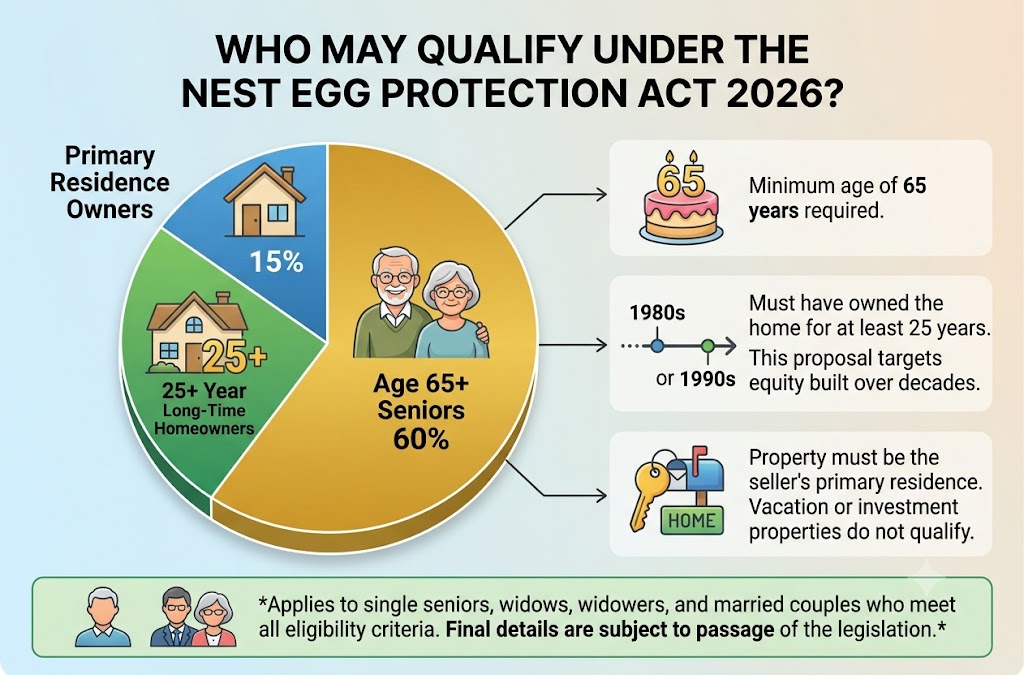
The proposal appears to target a narrow group of homeowners. The seller would need to be age 65 or older. The property would need to be the person’s primary residence. The homeowner would also need to have owned that home for at least 25 years.
That 25-year rule is important. This proposal is not designed for someone who bought a home five years ago and earned a quick profit. It is mainly aimed at long-time owners who built equity slowly over decades. Think of a retiree who bought a home in the 1980s or 1990s, raised a family there, and now wants a smaller place.
The proposal may also treat single filers and married couples differently from current law. Under current law, the maximum exclusion is lower for single filers than for qualifying married couples. Under the proposed senior-focused rule, reports say the exclusion could be up to $1 million for both individuals and married couples. That detail would be especially important for widows, widowers, and single senior homeowners in high-cost cities.
How the $1 Million Exclusion in the Nest Egg Protection Act 2026 Could Help Seniors
The higher exclusion could help seniors who feel trapped in a house that no longer fits their life. A big family home may become expensive to maintain after retirement. Property taxes, repairs, stairs, yard work, and insurance can all feel heavier with age. Selling may look smart, but a large taxable gain can make the move feel costly.
For example, imagine a senior bought a home for $150,000 and sells it decades later for $950,000. That does not mean the taxable gain is exactly $800,000, because improvements and selling costs can affect the calculation. Still, the gain could be far above the current $250,000 single-filer exclusion. A higher exclusion could leave more money available for a smaller home, assisted living, medical costs, or retirement income.
The wider housing market could also feel an effect. If more seniors list homes, buyers may see more inventory. That does not mean prices would suddenly become cheap. Housing supply is a big puzzle with many pieces. But freeing up long-held homes could help in markets where inventory is tight.
Nest Egg Protection Act 2026 vs. Current Law Table
| Feature | Current IRS Home-Sale Rule | Proposed Senior Rule |
| Legal status | Current law | Proposed bill, not current law |
| Maximum exclusion for single filers | Up to $250,000 | Up to $1 million |
| Maximum exclusion for married filing jointly | Up to $500,000 | Up to $1 million |
| Age requirement | No special 65+ requirement for the general rule | Age 65 or older |
| Ownership requirement | Usually 2 of the last 5 years | At least 25 years |
| Home type | Main home / primary residence | Primary residence |
| Timing | Applies now if requirements are met | Would apply only if passed and effective |
The Nest Egg Protection Act 2026 would be a major shift because it would raise the exclusion for qualifying seniors while adding a long ownership requirement. Current law is broader because it can apply to younger homeowners too. The proposed rule is narrower but more generous for the seniors who qualify.
Pros and Cons of the Proposed Nest Egg Protection Act 2026
👍 Pros (Potential Benefits):
- Massive Tax Relief: Allows qualifying seniors to protect up to $1 million in home sale profits from federal capital gains tax.
- Easier Downsizing: Leaves seniors with more cash to pay for assisted living, medical care, or a smaller, more manageable home.
- More Housing Supply: Could encourage long-time owners to sell, unlocking inventory for younger families and first-time buyers.
👎 Cons (Potential Drawbacks):
- It Is Not Law Yet: It’s currently just a proposal, creating frustrating uncertainty for seniors who need to sell right now.
- Strict 25-Year Rule: Only benefits homeowners who have lived in the exact same primary residence for at least 25 years.
- Regional Imbalance: Likely provides the biggest benefit to homeowners in high-cost coastal cities (like New York or California) rather than average-cost areas.
What Seniors Should Do Before Selling
The Nest Egg Protection Act 2026 is worth watching, but it should not replace basic planning. Seniors thinking about selling should first estimate their cost basis. That usually starts with the purchase price, then adds qualifying improvements. A kitchen remodel, room addition, new roof, or major system upgrade may increase basis, while normal repairs usually do not.
Next, homeowners should estimate selling costs. Agent commissions, transfer taxes, legal fees, and closing costs may reduce the taxable gain. They should also check whether they meet the current IRS ownership and use tests. If they used the exclusion recently, the two-year look-back rule may matter.
A smart next step is to speak with a qualified tax professional before signing a contract. This is especially true for widows, widowers, people who inherited part of a home, owners with rental history, and seniors moving to another state. The rules can become more complex when life gets more real.
Conclusion
The Nest Egg Protection Act 2026 could become an important tax proposal for seniors who have owned their homes for decades. If passed, it may allow some homeowners age 65 or older to exclude up to $1 million in capital gains from the sale of a primary residence they have owned for at least 25 years. That could make downsizing easier and help older homeowners protect more of their home equity.
But today, the bill is still only a proposal. Current IRS rules still control home sales unless and until the law changes. That means eligible sellers generally have the $250,000 single-filer exclusion or the $500,000 married-filing-jointly exclusion. Seniors should watch the bill, keep good records, and get professional tax help before selling.
FAQs
1. Is the Nest Egg Protection Act 2026 already law?
No. The Nest Egg Protection Act 2026 is a proposed bill, not current law. Seniors cannot claim the proposed $1 million exclusion unless Congress passes the bill and it becomes law.
2. What is the current IRS home-sale exclusion?
Under current IRS rules, eligible homeowners may generally exclude up to $250,000 of capital gain if single or up to $500,000 if married filing jointly. Sellers usually must meet ownership, use, and look-back rules.
3. Who could qualify for the Nest Egg Protection Act 2026?
The Nest Egg Protection Act 2026 proposal is aimed at homeowners age 65 or older who sell a primary residence they have owned for at least 25 years. Final eligibility rules could change if lawmakers revise the bill.
4. Would the Nest Egg Protection Act 2026 help married couples and single seniors?
Yes, as proposed, the Nest Egg Protection Act 2026 could allow up to a $1 million exclusion for qualifying seniors. Reports say the proposed limit may apply to both individuals and married couples, but final law would decide the exact rules.
5. Should seniors wait to sell because of the Nest Egg Protection Act 2026?
Seniors should not rely on the Nest Egg Protection Act 2026 until it becomes law. A sale decision should be based on current IRS rules, housing needs, health, retirement plans, and advice from a qualified tax professional.
Disclaimer
This article is for general educational purposes only. It is not tax, legal, investment, or financial advice. Tax rules can change, and each homeowner’s situation is different. Before selling a home or making a tax decision, speak with a qualified tax professional, CPA, attorney, or financial advisor.

“Hi, I am Devel Gupta, an entrepreneur and the founder of FinanceWithDevel. With 10 years of experience in teaching and simplifying personal finance, my mission is to help beginners build long-term wealth without the confusing jargon. Whether it’s budgeting, investing, or retirement planning, I believe financial freedom starts with simple, consistent habits. Let’s make money make sense. Connect with me on [ LinkedIn/Twitter ] for more daily tips!”