Introduction
How to Start Saving for Retirement With Little Money is a question many beginners ask when their budget already feels full. Rent, groceries, fuel, debt payments, insurance, and surprise bills can make retirement planning feel like a luxury for high earners. But retirement saving does not have to begin with a large amount. It can begin with $5, $10, or $25 a week, as long as the habit is consistent. The first win is not becoming rich quickly; the first win is proving that your future self deserves a place in your monthly budget.
How to Start Saving for Retirement With Little Money matters even more in 2026 because many households are under pressure. The IRS says the 2026 employee contribution limit for 401(k), 403(b), most 457 plans, and the federal Thrift Savings Plan is $24,500, while the IRA contribution limit is $7,500. Those numbers are helpful, but they can scare beginners because most people cannot save anywhere near the maximum in the beginning. That is okay. Retirement wealth is built in layers, and the first layer is simply starting.
Why Starting Small Is Better Than Waiting
This journey begins with one powerful truth: time can be more valuable than a perfect starting amount. If you wait until your income doubles, your debt disappears, or life becomes completely stable, you may wait for years. Small savings may look weak at first, but they build discipline, confidence, and momentum. Like planting a tiny seed, the result is not visible immediately, but the growth begins under the surface. The habit you build today can become the financial strength you rely on later.
How to Start Saving for Retirement With Little Money is also important because compound growth rewards patience. To see how even small monthly savings can grow over time, try this free compound interest calculator.gov explains that compounding allows money to grow over time, which is why early investing can become powerful over long periods. This does not mean every investment will rise smoothly, and it does not remove risk. It simply means money needs time to work. When you start early, even with a small amount, you give your money more years to grow.
2026 Retirement Numbers You Should Know
How to Start Saving for Retirement With Little Money becomes easier when you understand the main retirement numbers without getting overwhelmed by them. For 2026, the IRS increased the IRA limit to $7,500 and the employee contribution limit for many workplace plans to $24,500. People age 50 and older may also qualify for additional catch-up contributions. These are maximum limits, not minimum requirements. Beginners should treat them as future goals, not pressure points.
| Retirement Item | 2026 Figure | Why It Matters |
|---|---|---|
| 401(k), 403(b), most 457 plans, TSP employee limit | $24,500 | Maximum workplace plan employee contribution |
| IRA contribution limit | $7,500 | Useful for eligible traditional or Roth IRA savers |
| IRA catch-up age 50+ | $1,100 extra | More room for older savers |
| Emergency savings discomfort | 60% of Americans | Shows many people are financially stretched |
| U.S. personal saving rate, March 2026 | 3.6% | Shows saving is difficult for many households |
Bankrate’s 2026 Emergency Savings Report found that 60% of Americans were uncomfortable with their emergency savings. This matters because retirement saving and emergency saving are connected. If you do not have even a small cash cushion, one unexpected bill can push you into credit card debt or force you to stop investing. So, your plan should include both future wealth and short-term protection.
According to Bankrate’s 2026 Emergency Savings Report, many Americans still feel uncomfortable with their emergency savings, which is why a small starter fund is so important.
Move 1: Start With a Tiny Weekly Amount
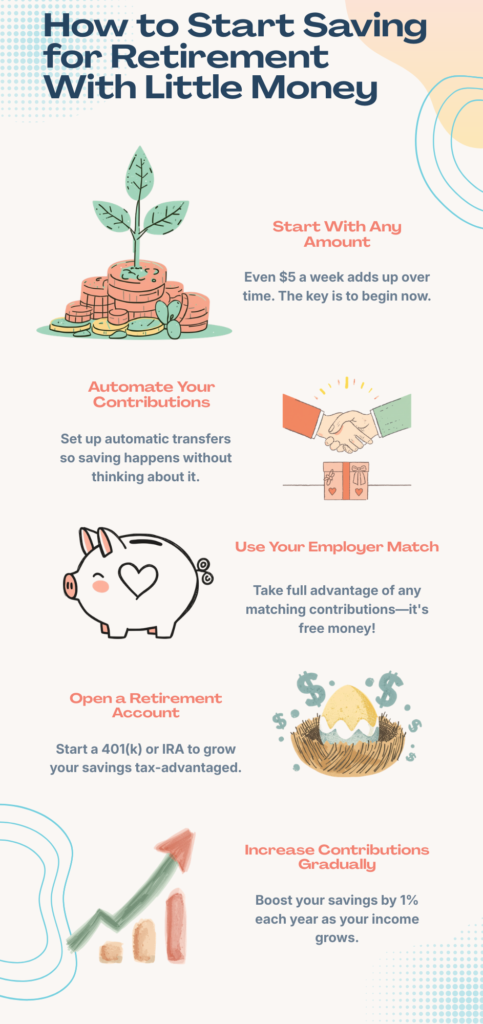
Starting your retirement journey should begin with an amount that feels almost too easy. If $100 a month feels impossible, try $5 a week. If $5 feels manageable, try $10 or $15. The goal is not to impress anyone with a big contribution. The goal is to create a saving habit that does not collapse when life gets busy, expensive, or stressful.
Treating the first 90 days like a simple challenge works best. Choose one weekly amount and automate it if possible. Do not keep changing the number every week. Let your brain get used to the idea that retirement saving is normal. After 90 days, review your budget and increase the amount slightly if you can.
Move 2: Grab the Employer Match First
Your saving plan becomes much easier if your employer offers a retirement match. A match means your employer adds money when you contribute money, usually up to a certain percentage of your pay. This can be one of the closest things to “free money” in personal finance. If you ignore the match, you may be leaving part of your compensation unused. Even if you cannot contribute a lot, try to contribute enough to get at least some of the match.
you do not need to max out your 401(k) right away. Start by checking your plan rules or asking HR how much you need to contribute to receive the full match. Moving from 1% to 2% is still progress. Small steps count when
Move 3: Automate Retirement Saving
Building this habit is easier when saving happens before spending. If you wait until the end of the month to save whatever is left, there may be nothing left. Money disappears through food delivery, small shopping, subscriptions, fuel, fees, and random expenses. Automation protects your retirement contribution from daily temptation. It turns saving into a system instead of a monthly argument with yourself
Set up automatic payroll deductions, bank transfers, or IRA contributions near your payday. Once the transfer happens, adjust your spending around what remains. A strong system is better than relying on motivation every month.
Move 4: Build a Small Emergency Fund
A solid financial plan should not ignore emergencies. A retirement account is for the future, but an emergency fund protects the present. Without emergency cash, one car repair, medical bill, or late paycheck can force you to use debt or withdraw retirement savings. That can damage both your confidence and your long-term growth.
Build a starter emergency fund alongside your retirement savings. Begin with $300, $500, or $1,000 depending on your situation. You might put $15 a week into emergency savings and $10 a week into retirement. Once your starter fund is ready, send more money toward retirement.
Move 5: Choose a Simple Retirement Account
You do not require a complicated account strategy to begin. If you have a workplace plan with a match, that is usually a strong first option. If you do not have a workplace plan, a Roth IRA or traditional IRA may be useful. A Roth IRA uses after-tax money and can offer tax-free qualified withdrawals in retirement. A traditional IRA may offer current tax benefits depending on your income and eligibility.
Do not spend months trying to choose the perfect account. Learn the basics, check eligibility, and start with the option that fits your life today. Progress beats perfection.
Move 6: Cut One Silent Expense
How to Start Saving for Retirement With Little Money can begin by redirecting money you already spend. Look for one expense that gives you little value, such as an unused subscription, delivery fee habit, premium app, bank charge, or impulse purchase. Do not say, “I will spend less,” because that is too vague. Say, “I will cancel this $12 monthly expense and invest that $12.” Giving saved money a destination keeps it from disappearing somewhere else.
How to Start Saving for Retirement With Little Money should not make your life miserable. You do not need to cut every enjoyable thing from your budget. The smarter approach is to remove low-value spending while keeping expenses that genuinely improve your life. This makes saving feel disciplined instead of painful. If retirement saving feels like punishment, you are less likely to continue.
Move 7: Increase Savings Slowly
How to Start Saving for Retirement With Little Money starts small, but it should not stay small forever. Once your first contribution becomes comfortable, increase it gradually. A 1% increase every few months can be powerful over time. If you earn $40,000 a year, 1% is about $400 per year before taxes. That may be easier than trying to jump from zero to a large amount overnight.
How to Start Saving for Retirement With Little Money becomes stronger when you connect increases to life events. When you get a raise, bonus, tax refund, side income, or lower bill, send part of the extra money toward retirement before lifestyle upgrades take over. You can still enjoy some of the extra cash. The key is not letting every increase in income become an increase in spending. This is how small saving turns into serious long-term wealth.
Move 8: Invest Simply, Not Perfectly
How to Start Saving for Retirement With Little Money often fails when beginners make investing too complicated. You do not need to study every stock, predict every market crash, or understand every financial term before starting. For many beginners, diversified funds, broad index funds, or target-date retirement funds can be easier than choosing individual stocks. Retirement investing should be steady, boring, and long-term. Boring can be beautiful when it keeps you consistent.
How to Start Saving for Retirement With Little Money also means avoiding gambling with your future. Do not chase viral stock tips, risky trends, or promises of guaranteed returns. Your retirement account is not a casino. Learn slowly, keep costs reasonable, diversify, and stay focused on decades, not days. A simple plan you can follow is better than a complex plan you abandon during the first market drop.
Move 9: Protect Your Retirement Money
How to Start Saving for Retirement With Little Money is not only about putting money in; it is also about keeping it there. Early withdrawals can create taxes, penalties, lost growth, and regret. Even small withdrawals can hurt because they break the habit and reduce the money that could have compounded over time. Treat retirement money as money for your older self, not as backup cash for short-term wants.
How to Start Saving for Retirement With Little Money also requires emotional protection during market downturns. Investments can fall, and headlines can feel scary. But retirement is usually a long game. If your investments match your age, goals, and risk tolerance, do not panic every time the market moves. Review your plan calmly instead of reacting emotionally.
Sample Beginner Plan
A simple monthly plan can make retirement saving feel less confusing. If your budget is very tight, you might begin with $5 per week for retirement and $10 per week for emergency savings. If your budget is more stable, you might save $25 per week for retirement and $25 per week for emergencies until your starter fund is ready. If you have employer matching, prioritize contributing enough to capture it over time. The plan should fit your life, not someone else’s Instagram budget.
| Budget Situation | Retirement Saving | Emergency Saving | Next Step |
|---|---|---|---|
| Very tight | $5/week | $10/week | Increase after 90 days |
| Tight but stable | $10/week | $15/week | Automate both |
| Moderate | $25/week | $25/week | Use employer match |
| Side income available | 50% of extra income | 25% of extra income | Avoid lifestyle inflation |
The best beginner plan is flexible. Some months will be smooth, and some months will be messy. If you miss one contribution, do not quit. Restart on the next payday. People who build wealth are not perfect; they simply return to the plan faster.
Common Mistakes to Avoid
How to Start Saving for Retirement With Little Money becomes difficult when you believe small amounts are pointless. This belief is dangerous because it keeps you stuck at zero. If you cannot save $500 a month, save $50. If you cannot save $50, save $10. The habit can grow later, but it must start first.
Another common mistake is comparing your beginning to someone else’s highlight reel. Someone online may show a huge retirement balance, but you do not know their income, age, family support, debt level, or risk history. Your real competition is your past self. If you saved nothing last year and you save something this year, you are improving. That is what matters.
Educational Disclaimer
This article is written for educational and informational purposes only.
It is designed to help beginners understand basic retirement saving ideas, budgeting habits, and long-term wealth-building strategies. It should not be considered personal financial, investment, tax, or legal advice. Everyone’s income, expenses, age, risk tolerance, and financial goals are different, so before making any major retirement or investment decision, consider speaking with a qualified financial advisor or tax professional.
Conclusion
How to Start Saving for Retirement With Little Money is possible even if your income is modest and your budget feels tight. You can start with a tiny weekly amount, collect an employer match, automate savings, build a small emergency fund, choose a simple account, cut one quiet expense, increase slowly, invest simply, and protect your money. These moves are not flashy, but they work because they are realistic. Retirement wealth is not built by one perfect decision; it is built by repeated decisions that point in the same direction.
Your future self does not need you to be perfect today. Your future self needs you to begin. Start small, stay consistent, and let time become your financial partner.
FAQs
1. Can I start saving for retirement with only $10 a week?
Yes, $10 a week is enough to start because the habit matters first. Over time, you can increase the amount as your income improves or your expenses fall. Small contributions also help you build confidence. The worst contribution is not a small one; it is no contribution at all.
2. Should I save for retirement or pay off debt first?
It depends on your debt and whether your employer offers a match. High-interest debt should usually be attacked seriously because it can grow quickly. But if you have an employer match, contributing enough to get some match may still be useful. A balanced plan can help you reduce debt while still building your future.
3. What account should a beginner use?
A workplace plan with an employer match is often a strong first choice. If you do not have access to one, a Roth IRA or traditional IRA may be useful depending on your income and tax situation. Self-employed people may have more options. The best account is the one you understand and actually use.
4. What if my income changes every month?
Use a percentage instead of a fixed amount. For example, save 5% of every payment you receive. In higher-income months, you save more, and in lower-income months, you save less. This keeps the habit flexible and realistic.
5. Is it too late to start in my 40s or 50s?
It is not too late, but you may need a stronger plan. You may have to save more, work longer, reduce expenses, use catch-up contributions if eligible, or improve your income. Do not let regret waste more time. Starting now is still better than waiting another year.
For a complete beginner-friendly explanation, read this full guide on retirement saving for beginners
and for more visit financewithdevel.com
Start Your 7-Day Retirement Saving Challenge
Reading about retirement saving is easy, but the real change starts when you take one small action. So here is a simple challenge for you: for the next 7 days, look closely at your spending and find just one small amount you can save. It could be $5 from coffee, $10 from food delivery, or $20 from an unused subscription. The amount does not need to be big. The goal is to prove to yourself that you can start.
Once you find that small amount, transfer it into a savings account, IRA, 401(k), or any retirement account available to you. This one step may look small today, but it can become the beginning of a powerful long-term habit. Remember, wealth is not built only by people who earn more; it is built by people who start early, stay consistent, and keep improving.
Now ask yourself this: What is one expense I can reduce this week to start saving for retirement? Write it down, take action, and come back to this guide whenever you need motivation. Your future self will thank you for the small decision you make today.
Join the Conversation
What is your biggest challenge when it comes to retirement saving — low income, high expenses, debt, or lack of knowledge? Share your thoughts in the comments below. Your question may help another beginner who is facing the same problem.
Also, if this guide helped you understand how to start saving for retirement with little money, share it with a friend, family member, or coworker who needs a simple retirement plan. Sometimes one helpful article can become the first step toward someone’s better financial future

“Hi, I am Devel Gupta, an entrepreneur and the founder of FinanceWithDevel. With 10 years of experience in teaching and simplifying personal finance, my mission is to help beginners build long-term wealth without the confusing jargon. Whether it’s budgeting, investing, or retirement planning, I believe financial freedom starts with simple, consistent habits. Let’s make money make sense. Connect with me on [ LinkedIn/Twitter ] for more daily tips!”